
How Often Should You Really Vacuum Your House?
The answer isn’t the same for everyone.
There are two kinds of people. The first sees one crumb on the floor and immediately reaches for the vacuum. The second looks at the same crumb for four days and thinks, I’ll get that eventually.
So who’s doing it right?
Like most things involving vacuum cleaners, the answer is annoyingly: it depends.
How often you should vacuum has a lot less to do with an arbitrary cleaning schedule and a lot more to do with what actually happens inside your home.
Once a Week Is a Good Starting Point — Not a Rule
The Carpet and Rug Institute recommends vacuuming carpet at least once a week as a general starting point. But areas that get heavier use may need much more attention: daily for high-traffic or pet areas, about twice a week for medium-traffic areas, and weekly for lighter-use areas.
That sounds like a lot until you think about what your floors deal with.
Shoes bring in grit and dirt. Pets bring in hair, dander and whatever they collected outside. Kids bring in... honestly, we’re not entirely sure what kids bring in. Somehow there’s always sand.
And even if your carpet looks clean, that doesn’t necessarily mean it is.
Your House Gets a Vote
Two adults living in a small home with no pets probably don’t need the same vacuuming routine as a family with three kids, two dogs and a backyard.
Pets? You’ll probably want to vacuum more often, particularly the areas where they spend the most time. Kids? Congratulations. You have somehow created crumbs in rooms where nobody remembers eating.
Mostly hard floors? Dirt is usually easier to see, so you may find yourself doing quick cleanups more frequently. Lots of carpet? Regular vacuuming becomes especially important because soil can work its way down into the carpet pile where you can’t easily see it.
And high-traffic areas deserve more attention than the guest room nobody has entered since Christmas. Your entrance, hallways, stairs and living room are taking far more abuse than every other square foot of your home.
Vacuuming Isn’t Just About Making the Floor Look Clean
This is the part people often don’t think about.
One of the reasons carpet manufacturers emphasize regular vacuuming is that dry soil can actually contribute to carpet wear. Shaw notes that gritty particles left in carpet can abrade the pile as people walk over it — essentially creating tiny amounts of wear over time.
In other words, that little bit of grit near the front door isn’t just ugly. Every person walking over it is helping work it farther into the carpet.
There’s an indoor-air reason to keep up with it too. The American Lung Association recommends vacuuming carpets and rugs with a HEPA-filter vacuum at least weekly as one measure to help reduce dust and other indoor pollutants.
So vacuuming isn’t only about achieving those satisfying carpet lines. Although we fully support the carpet lines.
Do You Need to Vacuum the Entire House Every Day?
Please don’t make vacuuming your second job.
If your entrance gets dirty every day, vacuum the entrance. If your dog has one favourite spot where enough hair accumulates to construct a second dog, vacuum that area more often. If nobody has stepped into the spare bedroom all week, it can probably wait.
A much more realistic approach is to vacuum according to use rather than treating every room exactly the same.
Quickly doing the busiest areas a few times during the week and giving the whole house a proper vacuum once a week may make far more sense than repeatedly cleaning rooms that aren’t actually dirty.
And Slow Down a Little
Here’s another interesting recommendation from the Carpet and Rug Institute: a quick once-over isn’t necessarily the most effective way to vacuum. They recommend slow, overlapping passes so the vacuum has an opportunity to remove soil from the carpet.
Which means racing through the living room at Formula 1 speed because company is coming technically counts as vacuuming... but we’re not promising it counts as good vacuuming.
So, How Often Should You Vacuum?
For most homes, once a week is a reasonable baseline, with high-traffic areas getting attention more often. Pets, kids, carpeting, outdoor traffic and your own tolerance for crumbs will move that number up or down.
The bigger lesson is that there isn’t one perfect schedule.
And just as important as how often you vacuum is whether you’re using the right vacuum for your home. A house full of carpet, pets and kids has very different cleaning demands than a small condo with mostly hard floors.
If you’re not sure whether your vacuum is actually keeping up with your home, come see us at A Vacuum Store & Service. Tell us about your floors, your pets, your stairs, your cleaning habits — and your household’s mysterious ability to produce crumbs.
We’ll help you find a vacuum that actually makes sense for the way you live.
No pressure. No sales pitch. Just real vacuum experience from people who see what works — and what doesn’t — every day.

Can the Wrong Vacuum Damage Your Carpet? What Most People Don’t Realize
The vacuum that works beautifully on one carpet may be completely wrong for another. Brush design, floorhead height, carpet construction and even the condition of the powerhead can all make a difference.
When someone comes into our store looking for a vacuum, one of the first things we ask is what kind of flooring they have. Very often the answer is simply, “Carpet.” But that usually leads to another question from us: what kind of carpet?
It might sound like we’re overcomplicating things, but carpet isn’t just carpet. There’s low pile, plush, dense soft carpet, Berber and other loop styles, wool, frieze, shag and all kinds of area rugs. They don’t necessarily need the same type of vacuum or the same kind of brush action.
Most people put a lot of thought into choosing new carpet. They look at colour, texture, softness, durability and price, and depending on the home, that carpet can be a pretty significant investment. What often gets overlooked is whether the vacuum they already own is actually appropriate for it.
And yes, the wrong vacuum, floorhead or setting can potentially damage certain types of carpet.
This isn’t one of those vacuum-store stories designed to scare you into buying something new. The Carpet and Rug Institute (CRI) and major carpet manufacturers actually publish guidance about choosing and using vacuums on different carpet constructions. CRI specifically notes that some rotating brush rolls can cause accelerated texture change on certain high-pile carpets, while manufacturers such as Shaw give different vacuuming recommendations depending on the carpet style.
Does That Mean Brush Rollers Are Bad for Carpet?
Absolutely not, and this is where the conversation can get confusing.
For most conventional carpet, a properly designed rotating brush is exactly what we want. Carpet holds dirt differently than hard flooring. Sand, grit, hair and other debris can work their way between the fibres, so effective carpet cleaning usually involves more than simply putting strong suction over the surface.
A good carpet powerhead uses its brush roller to agitate the carpet and loosen that embedded debris while the vacuum’s airflow carries it away. That combination of agitation and airflow is one of the reasons a good powerhead can make such a noticeable difference on carpet.
A vacuum can be an excellent machine and still be the wrong match for a particular floor.
Some Carpets Need a Much Gentler Approach
This becomes especially important with specialty carpets. The Carpet and Rug Institute warns that some rotating brush rolls can cause accelerated texture change on certain high-pile carpets, including high-nap and shag styles, and in some cases that change can be irreversible.
Shag is probably the easiest example to picture. Anyone who has ever cut long human hair out of a brush roller already knows what happens when long fibres meet a fast-spinning brush.
Now imagine those long fibres are attached to your floor. ????
That’s why certain long-pile and shag carpets may require suction-only cleaning or a vacuum where the rotating brush can be raised completely away from the carpet.
Loop-style carpets can also require more consideration. Depending on the construction and fibre, aggressive brushing can contribute to fuzzing or changes in appearance, and you certainly don’t want a damaged component underneath a vacuum catching an already loose loop and pulling it further.
Wool deserves its own mention as well. CRI’s consumer guidance recommends suction-only vacuuming for wool carpet, while individual wool carpet and rug manufacturers may have their own specific care instructions. If you’ve invested in a beautiful wool carpet or area rug, this is one of those times when reading the little care booklet nobody wants to read is actually worth it.
The goal is to remove the dirt, not take some of the carpet along for the ride.
When Your New Carpet Suddenly Makes Your Vacuum Impossible to Push
This is another situation we hear about fairly often. Someone has had new carpet installed and suddenly the vacuum they’ve used for years feels completely different.
“There has to be something wrong with this vacuum. I can barely move it.”
Sometimes there is a problem with the vacuum, but sometimes the new carpet and the floorhead simply aren’t a good match.
Very dense, plush and ultra-soft carpets can create a strong seal around certain vacuum nozzles. The vacuum may suddenly feel like it has attached itself to the floor. That doesn’t necessarily mean you’re getting some incredible deep clean because the suction is so powerful. If the nozzle seals too tightly against the carpet, airflow and manoeuvrability can become an issue.
This is one reason we like adjustable carpet powerheads for many homes. Height adjustment isn’t there for decoration. It allows the floorhead to be matched more appropriately to different carpet piles.
There’s also a common belief that putting a powerhead on its lowest setting automatically gives you the deepest clean. Lower means closer, closer means stronger, and stronger must mean better.
Not necessarily.
You want the brush to make appropriate contact with the carpet while still allowing the powerhead and airflow to work properly. Too high and you may not get enough agitation. Too low and the vacuum can become unnecessarily difficult to push or overly aggressive for the carpet. Shaw’s carpet-care guidance similarly recommends adjusting vacuum height appropriately for the carpet pile.
If vacuuming the bedroom suddenly feels like you’re pushing a Buick uphill, we probably need to look at what’s happening.
More Suction Doesn’t Automatically Mean Better Carpet Cleaning
Vacuum marketing has trained people to look for power numbers: watts, air watts, Pascals, water lift and whatever other enormous number happens to be printed on the box.
Those specifications can tell us useful things about a vacuum, and suction and airflow absolutely matter. But when we’re talking about carpet, we’re just as interested in what is happening where the machine actually touches the floor.
What kind of brush roller does it have? How does that brush contact the carpet? Can the height be adjusted? Can the brush be switched off when necessary? Does the floorhead maintain proper airflow? Is the nozzle appropriate for that particular carpet construction?
You can have a very powerful vacuum attached to the wrong floorhead.
Your carpet doesn’t care how impressive the motor sounds. It cares about what’s running across its fibres.
Why the Powerhead Design Matters So Much
This is also one of the reasons we pay so much attention to the actual carpet powerhead when we recommend a vacuum. A good example is the SEBO ET-1 powerhead, which is one of our favourite carpet powerheads because of how much control it gives you over the way the brush interacts with the carpet.
The ET-1 uses a high-quality replaceable brush roller and offers four-level manual height adjustment. Instead of forcing the same brush position onto every carpet, the powerhead can be adjusted to better suit different carpet piles and maintain the proper relationship between the brush, carpet and airflow.
It also has electronic monitoring and protection built into the powerhead. If the brush becomes jammed or the height is set incorrectly, the system can alert the user and shut the brush down to help protect the powerhead and the flooring underneath it.
On compatible SEBO systems, the brush roller can also be switched off completely when straight-suction cleaning is more appropriate for a delicate rug or another surface where rotating brush action isn’t wanted.
That kind of adjustability is a big reason a well-designed powerhead can perform properly across different carpet types instead of treating every floor exactly the same.
What About Stick Vacuums?
This is where we think people need to pay a little more attention, especially if they have looped, high-pile, shag, wool or delicate carpet.
Many cordless stick vacuums rely heavily on a fast-spinning motorized brush roller for their carpet-cleaning performance. That can work extremely well on the right flooring, but many stick vacuums don’t offer the same type of traditional carpet-height adjustment you get with a full-size adjustable powerhead.
Depending on the model, you may also have limited ability — or no ability at all — to completely shut the brush roller off.
That doesn’t mean stick vacuums are bad, and it certainly doesn’t mean they can’t clean carpet. They can be fantastic for the right home. But a lightweight vacuum isn’t automatically a gentle vacuum, and on certain specialty carpets we would want to look very closely at the brush design before repeatedly running it across the floor.
If your carpet manufacturer recommends suction-only cleaning, limited brush action or a particular type of vacuum head, a fixed-height motorized brush that cannot be switched off may simply not be the right tool for that carpet.
When it comes to carpet, control over the brush can be just as important as the brush itself.
Sometimes the Vacuum Was Right — Until Something Wore Out
There’s another part of this conversation that people sometimes overlook: even the correct vacuum can eventually develop a problem that puts the flooring at risk.
Brush rollers wear. Bearings wear. Belts stretch or break. Hair and thread become wrapped around moving components. Wheels can become damaged. Plastic can crack, and occasionally something sharp gets lodged underneath the nozzle.
The vacuum may still turn on. It may still have plenty of suction. The brush might even still spin. That doesn’t mean everything underneath is in good condition.
It’s worth turning the vacuum over once in a while and actually looking at the floorhead. If something is cracked, sharp, jammed or visibly damaged, don’t repeatedly drag it across expensive flooring and hope for the best.
This is also why, when someone tells us their vacuum suddenly feels different on the carpet, we don’t automatically assume they need a new vacuum. Sometimes the vacuum is perfectly appropriate for the floor and the powerhead simply needs service.
Your Carpet Manufacturer Gets the Final Say
This may be the most important advice in this whole article.
If you’ve recently installed new carpet, check the manufacturer’s care and warranty information before deciding what type of vacuum to use on it.
We work with vacuums every day, but we didn’t manufacture your carpet. Different fibres, piles and constructions can have different requirements, and the carpet manufacturer knows how that particular product is supposed to be maintained.
The Carpet and Rug Institute even has a Seal of Approval program that evaluates vacuums for soil removal, dust containment and carpet appearance retention. In other words, cleaning performance isn’t only about how much dirt a vacuum removes; CRI also considers whether the machine adversely affects the carpet’s appearance.
A machine isn’t doing you any favours if it gets the dirt out while unnecessarily beating up the flooring underneath it.
This Is Why We Ask So Many Questions
If you’ve ever come into our store looking for a vacuum and felt like you were being interviewed, now you know why. ????
We want to know whether you have carpet, but we also want to know what kind. Is it low pile? Plush? Very soft? High pile? Wool? Mostly carpet with one delicate area rug? Do you have pets? Did you recently have new flooring installed?
We’re not trying to make buying a vacuum complicated. We’re trying to make sure the machine actually makes sense for your home.
Sometimes that means a good electric powerhead with adjustable height. Sometimes we want a brush roller that can be switched off. Sometimes a suction-only tool is the right answer for a particular rug. And sometimes the best advice we can give you is to check with the carpet manufacturer before buying anything.
There really isn’t one vacuum or one carpet setting that is perfect for every floor.
So, Can the Wrong Vacuum Damage Your Carpet?
Yes, certain combinations of carpet, brush roller, floorhead and settings can cause problems. But that doesn’t mean people should become afraid of vacuuming their carpets. Quite the opposite.
Regular vacuuming is an important part of carpet care. Dirt and grit left in carpet can contribute to wear of their own, which is why manufacturers recommend routine vacuuming in the first place. The key is making sure you’re using equipment that’s appropriate for the carpet you actually own.
For conventional carpet, a quality rotating brush may be exactly what you need. For certain high-pile, shag, wool or loop constructions, the recommendation may be very different. For dense, ultra-soft carpet, adjustability and proper airflow can make an enormous difference.
Before You Buy a Vacuum, Look Down
So the next time you’re shopping for a vacuum, don’t only look at the suction numbers, motor, filtration, battery life or fancy features.
Look down.
One of the most important things you need to know before choosing a vacuum is already underneath your feet.
And if you’re not sure what kind of vacuum is appropriate for your carpet, take a picture and bring it with you. If the carpet is new, bring the manufacturer and style information too. We can help you figure out what type of floorhead and cleaning system makes sense for it.
Because the goal isn’t simply to keep your carpet clean.
It’s to keep it clean without unnecessarily wearing out the carpet you paid good money for.
No pressure. No sales pitch. Just real vacuum experience from people who see what works — and what doesn’t — every day.

Are Expensive Vacuums Actually Worth It?
After more than 25 years selling and repairing vacuums in Calgary, here’s what we think really matters.
We get asked some version of this question all the time: “Do I really need to spend that much on a vacuum?”
And the answer might surprise you coming from people who sell vacuums for a living. No. You don't necessarily need an expensive vacuum. You need the right vacuum — and there's a difference.
After more than 25 years selling and repairing vacuums in Calgary, we've seen $1,000+ machines that were completely wrong for the person who bought them, and much less expensive vacuums that were exactly what someone needed and lasted for years.
We've also seen plenty of vacuums with impressive price tags, beautiful advertising and enough fancy terminology to make you think they're about to clean the house without you.
Unfortunately, you still have to vacuum.
Expensive Doesn't Automatically Mean Better
A higher price doesn't automatically mean a better vacuum. Neither does a famous brand, 14 attachments, Wi-Fi, a laser, an LCD screen or something called Hyper-Turbo-Max-Cyclonic Technology. Marketing departments have to stay busy too.
Those questions aren't nearly as glamorous, but five or ten years from now they're usually the ones that matter.
What Are You Actually Paying For?
With a genuinely good-quality vacuum, some of the extra money goes into things you don't immediately see: better motors, bearings, hoses, seals, filtration, stronger plastics, properly designed power nozzles and replaceable components.
And hopefully, parts availability. That's a big one for us.
We repair vacuums every day, so we don't just look at what a machine is like when it's shiny and new. We think about what happens seven years from now when something breaks.
Can we replace the motor, switch, hose, brush roller or belt? Or did one $30 component just turn a perfectly good vacuum into a very large piece of garbage?
Most people don't think about that while shopping for a shiny new vacuum. We do — because eventually, we see it again.
Repairable Matters
One of the biggest changes we've seen over the years is that there used to be an assumption that when something broke, you fixed it.
Now many products are designed around replacement instead of repair. A tiny piece breaks and the manufacturer only sells the entire assembly — or worse, the part isn't available at all.
Then we get to deliver everyone's favourite news: “Your vacuum works perfectly except for this one broken part... which apparently no longer exists.”
This is why manufacturer support matters. A $700 vacuum that lasts 15 years can be a much better value than a $300 vacuum you replace every three or four years.
The cheaper vacuum wasn't necessarily cheaper. You just bought it several times.
You Can Also Spend Too Much
Here's the part nobody selling vacuums is supposed to tell you: you can absolutely buy too much vacuum.
If you live in a small condo with mostly hardwood and one area rug, you probably don't need the same machine as someone with 3,000 square feet of carpet, two Golden Retrievers and children who believe Cheerios belong everywhere except inside a bowl.
This is why we ask about your flooring, carpet, pets, stairs, allergies and how you actually like to clean.
We're not being nosy. Well... maybe a little.
But we'd rather figure that out than simply point you toward the most expensive machine in the store. The best vacuum for your neighbour could be completely wrong for you.
Don't Buy a Vacuum Based on Suction Alone
Another question we hear constantly: “Which one has the most suction?”
Suction matters, but a giant suction number doesn't tell you how well a vacuum will actually clean your home.
Carpet needs a properly designed power nozzle and brush roller. Hard floors need the right floor tool. Pet hair needs good agitation. Different carpets may require different settings.
Filtration matters. Airflow matters. Tool design matters. A vacuum is a complete cleaning system.
It's a little like putting a Ferrari engine in a shopping cart. Impressive motor. Still not taking it on Deerfoot.
Don't Forget What It Costs After You Buy It
The price on the box isn't necessarily the true cost of owning a vacuum.
What do the filters cost? How often do they need replacing? What about bags, batteries and power nozzles? Can individual parts be replaced, or does one failure mean buying an entire assembly?
We've seen people hesitate over the cost of vacuum bags while owning a bagless machine that requires multiple expensive filters.
We've also seen cordless vacuums where a replacement battery costs enough to make you sit down before hearing the price.
There's nothing inherently wrong with bagged, bagless or cordless vacuums. Just know what you're signing up for.
A $1,000 Vacuum Shouldn't Be Disposable
This is where we get a little opinionated. If you're spending serious money on a vacuum, we think you should reasonably expect it to be serviceable.
That doesn't mean nothing will ever break. Good vacuums need repairs too. Brush rollers wear down, belts stretch, bearings wear, hoses get damaged and motors eventually reach the end of their lives.
That's normal. The important question is: Can we fix it?
We've had customers bring us vacuums they've owned for 15, 20 and even 25 years. Sometimes they need a motor or a hose. Sometimes they just need a proper cleaning and a few worn parts replaced.
And occasionally someone walks in carrying a vacuum old enough that we remember selling it to them.
That's when you realize you've been doing this for a while.
So...Are Expensive Vacuums Worth It?
Sometimes, absolutely. But there's no magic price where a vacuum suddenly becomes “good.”
We'd rather see someone spend $500 on the right vacuum than $1,200 on the wrong one.
For us, value isn't the price on the tag. It's how well the vacuum cleans your home, how easy it is to use, how long it lasts, what it costs to maintain and whether it can actually be repaired when something eventually wears out.
If spending more gets you better cleaning, proper filtration, better construction, available parts and many years of use, then yes — it can absolutely be worth it.
We're not judging. Much.
Don't buy the price tag. Buy the vacuum that makes sense for your home.
Look at how it's built, the actual filtration — not just the hype, the power nozzle and attachments, whether replacement parts are available, and whether somebody can realistically repair it five or ten years from now.
Most importantly, buy for the floors, pets and messes you actually have — not the beautifully spotless house in the commercial.
And if you're not sure, come see us. Tell us about your home, your flooring, your pets and how you actually clean. We'll explain the differences and help you figure out what makes sense. Sometimes that's one of our more expensive machines. Sometimes it isn't.
No pressure. No sales pitch. Just 25+ years of real vacuum experience in Calgary.

Can Your Vacuum Actually Improve the Air Quality in Your Home?
After more than 25 years in the vacuum business, there's one question we think more people should be asking about their vacuum.
When most people shop for a vacuum cleaner, they're thinking about what's happening on the floor.
Does it have good suction? Will it pick up pet hair? Will it actually clean my carpet?
Can it get whatever mysterious crumbs keep appearing underneath the kitchen table?
All very important questions, but after more than 25 years in the vacuum business, there's another question we think people should be asking:
What's coming OUT of your vacuum while you're cleaning?
Because a vacuum doesn't make dirt disappear. It sucks up dirt along with a huge amount of air, separates the two and, in the case of a portable vacuum, blows that air right back into your home.
So while everyone talks about what a vacuum picks up, we think it's just as important to talk about what it keeps inside — and what it sends back out.
First, Try the Smell Test
Here's a very simple test we tell people about all the time: turn on your vacuum and smell the exhaust air.
Does it smell like basically nothing? Great!
Does it smell like warm dust, dirty feet or a slightly damp Golden Retriever? Not so great.
That's usually your vacuum trying to tell you something. It could be an overdue bag, dirty filters, a bagless bin that needs a proper cleaning or hair and organic material that's been sitting somewhere inside the machine longer than you'd probably like to know.
Household dust isn't just "dust" either. It's a mixture of fine particles, pollen, pet dander, hair, skin cells, dirt and whatever else your family and pets have brought inside.
Research looking at vacuum cleaner dust and exhaust has even found bacteria and fungal material, and studies measuring vacuum exhaust have shown that some machines can release particles and bacteria-containing material while they're operating.
More importantly, researchers have found big differences between different vacuum cleaners in what gets released back into the air.
Now, your nose isn't a laboratory and smelling dirty exhaust doesn't automatically prove that your vacuum is blowing bacteria around your house. But if the machine you're using to make your house cleaner is making the entire room smell worse every time you turn it on, we wouldn't ignore it either.
Your vacuum shouldn't need Febreze following behind it.
"But My Vacuum Has a HEPA Filter"
We hear this one all the time.
And let's be clear — HEPA filtration is excellent. A true HEPA filter is designed to capture at least 99.97% of particles at 0.3 microns.
That's impressive filtration, but here's the part that doesn't always make it onto the giant HEPA sticker on the box:
For HEPA filtration to work the way you expect, the dirty air needs to actually pass through the HEPA filter. If air can escape around seals, connections, the dust compartment or other parts of the machine before reaching that filter, having an excellent filter doesn't tell you how well the entire vacuum cleaner is filtering.
Even the EPA makes this distinction when defining a HEPA vacuum. The machine has to be designed so that the air entering it is exhausted through the HEPA filter without bypassing it.
That's why we're much more interested in how a vacuum is designed and sealed as a complete system than simply seeing the word HEPA written somewhere on the box.
It's a little like buying the world's greatest furnace filter and then leaving a window open.
Great filter. Not quite the same result.
And there's another important distinction. HEPA filters are designed primarily to capture particles. Odours can come from gases and compounds that aren't necessarily removed by a HEPA filter.
So yes, you can technically have a vacuum with HEPA filtration that still smells like dirty socks when you turn it on.
If that's happening, we'd be checking the bag, filters, bin and cleanliness of the machine.
Why We're Still Big Fans of Bagged Vacuums
There's a reason many customers concerned about dust, pet dander and allergies eventually find their way back to a good-quality bagged vacuum — and no, it's not because we're stuck in 1998.
Modern high-filtration vacuum bags are very different from the basic paper bags people remember from decades ago.
A quality bag actually becomes part of the vacuum's filtration system, trapping and containing the dirt you're removing from your home. Then when it's full, you remove it, throw it away, install another and done!
With a bagless machine, everything you've collected eventually has to come back out of that bin. And anyone who's owned one knows how that sometimes goes.
You dump it. Half comes out. You shake it. You tap it against the garbage. A little cloud of dust comes out. There's hair wrapped around the cyclone.
Then you're reaching into the bin wondering how cleaning the house somehow turned into this.
Suddenly you're getting reacquainted with everything you spent the last week vacuuming up.
That's one of the reasons we often recommend quality bagged vacuums for homes where dust containment and indoor air quality are priorities. You're not only thinking about how efficiently the vacuum collects dirt — you're also thinking about how efficiently it keeps it contained until you dispose of it.
Central Vacuums Take It One Step Further
Then there are central vacuum systems, which approach the whole issue differently.
Instead of carrying the motor, dirt container and exhaust around your home with you, the main central vacuum unit is normally located in the garage, basement or utility room. You vacuum through wall inlets and the dirt travels through piping back to the central unit.
Many central vacuum systems can also be vented directly outdoors. So rather than having the motor exhaust blowing beside you while you're vacuuming the bedroom or living room, the entire collection system is located away from your main living space.
There has actually been research on this. One study involving people with documented house-dust allergies found improvements in several allergy-related quality-of-life measures when participants used a central vacuum system instead of their conventional vacuum.
Other research comparing central vacuums with good modern portable vacuums hasn't found the same significant difference in airborne dust and allergens.
And we think that's important to mention too. We're not going to tell you that installing a central vacuum magically turns your house into a sterile laboratory.
It doesn't.
But if indoor air quality is important to you, having the motor, collected dirt and potentially the exhaust outside your living area is certainly worth considering.
But Great Filtration Is Only Half the Job
Here's the part that sometimes gets forgotten. Your vacuum can have fantastic filtration, but first it has to actually remove the dirt from your floors. This becomes especially important with carpet.
We hear people say all the time: "I just need really strong suction."
Good suction matters, but suction alone isn't necessarily what deeply cleans carpet.
Pet hair, dust, sand and fine grit can work their way down into the carpet fibres. A properly designed brush roller agitates those fibres and helps loosen that material so the airflow can actually carry it away.
That's why a good motorized power nozzle can make such a difference compared with an air-driven turbine brush, particularly in homes with a lot of carpet, pets or heavier cleaning needs.
An electric power nozzle has its own motor driving the brush roller. It isn't depending on the vacuum's airflow to keep that brush spinning.
But — and this is important — more aggressive doesn't automatically mean better. The brush also needs to be appropriate for the carpet.
Different carpet styles and pile heights can require different brush heights and cleaning methods, and some delicate or very high-pile carpets shouldn't be aggressively brushed at all.
That's why we always come back to the same thing: the right tool for the right floor.
Research supports the importance of properly removing what's hiding in carpet too. One study involving 50 homes found that intensive HEPA vacuuming reduced carpet dust loading by about 55% and dust-mite allergen loading by about 81%.
That's a pretty good reminder that what's buried in your carpet matters just as much as what you can see sitting on top of it.
Your Attachments Matter Too
People spend a lot of time comparing vacuum cleaners and almost no time thinking about the tools attached to them, but attachments can make a huge difference.
A proper floor brush can get into the grooves and edges of hard flooring. A motorized power nozzle can agitate carpet. An upholstery tool can remove pet hair and dust from furniture. A dusting brush can clean areas that otherwise don't get vacuumed very often at all.
Even the best vacuum can't remove dust from somewhere the attachment can't properly reach or clean.
And attachments wear out too. Brush rollers wear down, floor-brush bristles wear and flatten, belts stretch, wheels wear and hoses can develop leaks.
So sometimes when someone tells us their vacuum "doesn't clean like it used to," the problem is what's attached to the end of it.
And Please...Change Your Filters
This might be one of the most common things we see when vacuums come into the store for service.
We'll open the machine, pull out a completely packed filter and hear: "There's a filter in there?"
And judging by the looks of it, it's been there through several Canadian prime ministers.
Filters don't last forever. Neither do bags, brush rollers, belts or seals.
A clogged filter can restrict airflow. A worn brush roller doesn't agitate carpet as effectively. Bagless cyclones and screens become coated with very fine dust. Hair accumulates around rollers and moving parts.
The machine may still turn on. It may still sound like a vacuum. It may still pick up the Cheerios.
That doesn't necessarily mean it's performing the way it did when it was new.
And if you've started noticing that familiar warm, dusty, dirty smell coming from the exhaust, checking the filters and overall cleanliness of the machine is a very good place to start.
So Can the Right Vacuum Help Improve Indoor Air Quality?
Yes — but we wouldn't choose one based on a HEPA sticker alone.
We look at the whole system: how well it actually removes dirt from your flooring, how well that dirt is contained once it's inside, whether the vacuum is properly sealed, the quality of the bags and filtration, where the exhaust goes, and what type of power nozzle or floor tool is being used.
And when it's finally time to empty the vacuum, can you dispose of everything you've collected without putting half of it right back into the room?
A well-designed bagged vacuum with quality filtration can be an excellent choice. A central vacuum, especially one vented outdoors, can be an excellent choice.
And using the correct power nozzle, floor brush and attachments matters just as much, because even the world's greatest HEPA filter can't capture dirt your vacuum never picked up in the first place.
So the next time you're shopping for a vacuum, don't only ask: "How much suction does it have?"
Ask: "What happens to everything after it gets sucked up?"
That's often the much more important question.
And if the air coming out of your current vacuum smells like wet dog even though you don't own a dog, bring it in. We should probably have a look. And if you have questions or want advice on which vacuum will best suit your cleaning needs, we're here and happy to help — stop by or give us a call!
No pressure. No sales pitch. Just 25+ years of real vacuum experience in Calgary.

Are Vacuum & Mop Combos Really Worth It? Here's Our Honest Take.
After more than 25 years working with vacuums every day, here's what we tell customers about vacuum-and-mop combo machines.
Every few months it seems like there's another machine promising to completely change the way we clean our homes.
Vacuum and mop at the same time, self-cleaning, self-drying, smart sensors, app controls — and on and on.
At this rate, we're just waiting for one to start unloading the dishwasher too.
We get asked about these machines all the time. Whether it's a Tineco, a Bissell CrossWave, a Shark HydroVac or one of the many robot vacuum-and-mop combinations, people want to know the same thing:
The short answer? Yes... for the right job.
The longer answer is a little more complicated. After more than 25 years working with vacuums every single day, we've learned that convenience and performance aren't always the same thing.
They're Great for Maintenance Cleaning
Where these machines really shine is in homes that are already fairly clean.
If you vacuum regularly and you're simply trying to keep hard floors looking nice between deeper cleans, they can absolutely save time.
They'll pick up yesterday's crumbs, a bit of dust, the dog's muddy paw prints after a walk, or the coffee you somehow managed to spill before your first sip.
For those everyday little messes, they're genuinely convenient.
Independent testing has also shown that many of these machines perform quite well on sealed hard flooring like tile, vinyl, laminate and hardwood when dealing with light debris and fresh spills.
That's exactly what they were designed to do.
But that's also where many people misunderstand what these machines are.
They're Maintenance Cleaners... Not Deep Cleaners
The advertising often makes it look like you'll never need another vacuum or mop again.
That's where we start to disagree.
A vacuum-and-mop combo simply can't do both jobs as well as two separate tools designed specifically for each task.
Think about it: one brush roll is expected to pick up dry dirt, hair, crumbs, sticky spills, pet accidents, muddy footprints and then somehow wash itself afterwards.
That's asking a lot from one brush roll.
Traditional vacuums separate dirt into a bag or dust bin while keeping moisture far, far away from the motor. Traditional mops focus only on washing the floor.
A combo machine is trying to do both jobs at once, and like most "jack of all trades" products, there are compromises.
If your floors haven't been cleaned in weeks, you've got construction dust, heavy pet hair, lots of sand, or kids who seem determined to bring the entire playground into your kitchen, these machines tend to struggle.
They work much better once the heavy dirt has already been removed.
"Self-Cleaning" Doesn't Mean Maintenance-Free
This is probably one of the biggest misconceptions we hear from customers.
People assume self-cleaning means they never have to touch the machine.
Unfortunately... that's not how it works.
Even the manufacturers recommend taking the machine apart regularly.
The dirty water tank needs to be emptied. The clean water tank needs refilling. Filters need rinsing. Brush rolls need cleaning. Hair needs to be removed. Recovery tanks need washing.
Many manufacturers even recommend leaving parts out to dry after every use to help prevent odours, mildew and bacteria from developing inside the machine.
In other words, the machine cleans itself... but you still have to clean the machine.
What About the Floors Themselves?
Another thing people don't often think about is how much water is being left behind.
Most vacuum-and-mop combos use a continuous flow of clean water while simultaneously recovering it.
Some do this better than others, but many still leave the floor noticeably damp.
That's usually fine for tile.
But with hardwood and some laminate flooring, excess moisture over time isn't something most flooring manufacturers recommend.
Many flooring care guides suggest using as little water as necessary and ensuring floors dry quickly to help reduce streaking, residue and unnecessary moisture exposure.
It's one of the reasons professional cleaners often finish with a dry microfiber pad after mopping.
A floor that's just slightly damp generally dries cleaner than one that's left wet.
So... Would We Recommend One?
Yes — but maybe not for the reason most people buy one.
If you already own a quality vacuum and you're looking for something to quickly freshen your kitchen, mudroom or bathroom a couple of times a week, they're a great addition.
They make everyday maintenance easier.
But if you're buying one because you think it'll completely replace a good vacuum and your regular mop...
We wouldn't count on it.
Our advice is still the same advice we've been giving customers for years: vacuum first, then mop.
It might not sound as exciting as all the marketing promises, but there's a reason professional cleaners still clean this way.
Removing the dry dirt first prevents you from simply turning dust and debris into muddy residue that gets pushed around the floor.
Sometimes the old-fashioned method is still the best method.
And we've repaired enough vacuums over the years to know that when one machine tries to do absolutely everything, it usually ends up doing several jobs pretty well instead of one job exceptionally well.
For us, a vacuum-and-mop combo is a helpful tool.
Just not a miracle one.
If it makes your everyday cleaning easier, great. Just go into it knowing what the machine is designed to do, what maintenance it needs and where its limitations are.
No pressure. No sales pitch. Just 25+ years of real vacuum experience in Calgary.

10 Everyday Habits That Could Be Shortening the Life of Your Vacuum
After more than 25 years repairing vacuums, we've learned that it's usually the little things that cause the biggest problems.
Have you ever had a vacuum quit on you way sooner than you expected? Maybe it started losing suction. Maybe it began making strange noises. Maybe it developed that unmistakable "something's burning" smell. Or maybe one day it simply refused to turn on.
When customers bring vacuums into our shop, one of the first things we hear is:
And most of the time, nothing dramatic happened at all.
It's usually the little things.
Over the years we've repaired thousands of vacuums — everything from inexpensive department store models to premium machines that have been faithfully cleaning homes for over twenty years.
One thing we've noticed is that most major repairs don't happen because someone abused their vacuum. They happen because of everyday habits that people simply didn't know could cause problems.
The good news? Most of these issues are completely preventable.
So before your vacuum starts protesting with funny noises or poor performance, here are some everyday habits that might be shortening its lifespan without you even realizing it.
1. Vacuuming Until the Bag (or Bin) Is Packed Full
We've all done it. You think, "There's still a little room left." Then a little more... then just one more room.
Whether you own a bagged or bagless vacuum, overfilling it is one of the easiest ways to reduce cleaning performance.
A full bag or packed dust bin restricts airflow. Less airflow means less suction. Less suction means the motor has to work harder just to pick up the same amount of dirt.
Think of it like trying to breathe through a straw while running a marathon.
Eventually something has to give.
One of the nicest surprises customers experience when switching to a quality bagged vacuum is discovering that modern vacuum bags don't lose suction nearly as quickly as people expect. In fact, many premium bags maintain excellent airflow until they're close to full.
The trick is replacing them before they're completely packed solid.
Your vacuum — and your floors — will thank you.
2. Forgetting About the Filters
Here's a question we ask customers all the time: "When was the last time you cleaned or replaced your filters?"
The most common answer? "It has filters?"
No judgment. We hear it almost daily.
Filters quietly do their job in the background, so it's easy to forget they even exist. But dirty filters can have a huge impact on performance.
A clogged filter restricts airflow, reduces suction, causes motors to run hotter and can even shorten the life of the machine.
Some filters are washable. Others need replacing. Every vacuum is a little different, which is why checking your owner's manual or asking your local vacuum shop is always worth it.
It's a small maintenance task that can save you a much bigger repair later.
3. Vacuuming Things Your Vacuum Was Never Designed to Pick Up
This one always makes us smile because almost everyone has done it.
You spill rice, coffee beans, drywall dust, cat litter, construction debris or baking soda.
"I'll just vacuum it quickly."
Sometimes that's perfectly fine. Sometimes it isn't.
Certain materials are incredibly fine and can clog filters almost immediately. Others can damage brush rollers, scratch internal parts or create blockages that are difficult to remove.
One of the biggest offenders? Construction dust.
Drywall dust is incredibly fine and can work its way into areas of the motor where regular household dust normally wouldn't.
If you're renovating your home, your regular household vacuum probably shouldn't be your cleanup crew. That's a job for a proper shop vacuum.
4. Never Checking the Brush Roller
If you have long hair, pets or family members with long hair... this one is for you.
Hair has an incredible talent for wrapping itself around brush rollers.
At first it doesn't seem like much, but week after week, month after month, that little bit of hair slowly builds into what looks suspiciously like a small furry animal wrapped around your vacuum.
Eventually the brush roller can't spin properly. Performance drops. The belt works harder. The motor works harder. In some cases, the brush roller can even seize completely.
A quick check every few weeks can prevent all of that.
And if your vacuum has an easily removable brush roller, like many quality SEBO models, it can take just a couple of minutes to clean.
5. Using the Wrong Attachment
Vacuum attachments aren't just there to make the box look impressive. Each one actually has a purpose.
A hard-floor brush glides across hardwood, tile and laminate. A motorized power nozzle deep cleans carpet. An upholstery tool works wonders on furniture and stairs.
Yet we often see people using the carpet nozzle on hardwood or the hard-floor brush on thick carpet.
Can it work? Sometimes.
Will it clean as well? Usually not.
Using the right attachment isn't about making cleaning more complicated. It's about making it easier.
6. Ignoring Strange Noises
Your vacuum talks to you.
Not with words, of course — with sounds.
If it suddenly becomes louder, starts squealing, grinding, whistling or making a noise you've never heard before...
Don't just turn the TV up louder.
Strange noises are usually your vacuum's way of saying something needs attention.
Sometimes it's a simple blockage. Sometimes it's a worn bearing. Sometimes it's a brush roller that's asking for help.
Catching the problem early is often the difference between a simple repair and a much larger one.
7. Wrapping the Cord Too Tightly
This is one of those habits almost nobody thinks about.
Wrapping the power cord tightly around the vacuum every single time slowly stresses the wires inside. Over the years, that repeated bending can eventually lead to broken internal wiring.
Instead, try wrapping the cord a little more loosely and avoid pulling it tight around sharp corners.
Your future self will appreciate it.
8. Waiting Until Something Breaks Before Having It Checked
Most people service their car. Change the oil. Rotate the tires. Replace worn parts before they fail.
But the vacuum? It often gets ignored until smoke starts coming out.
Professional service isn't just about fixing problems. It's also about preventing them.
During routine service, worn belts, clogged airways, dirty motors, tired brush rollers and small issues can all be caught before they become expensive repairs.
Think of it as giving your vacuum a yearly health check.
9. Assuming Every Vacuum Is Maintenance-Free
Modern marketing has convinced a lot of people that vacuums don't require maintenance anymore.
We wish that were true.
Every vacuum — whether it's cordless, upright, canister or central — needs some attention.
Filters need cleaning. Brush rollers need checking. Bags need replacing. Hoses occasionally clog. Even the best-built machines benefit from a little care.
The good news? A few minutes of maintenance every month can add years to your vacuum's life.
10. Replacing the Vacuum Instead of Fixing the Problem
This one might be the biggest mistake of all.
A customer walks into our shop carrying a vacuum that "doesn't work anymore," and they're convinced it's finished.
Then we find a clogged hose. A worn belt. A full filter. A brush roller wrapped in hair. A loose electrical connection.
And sometimes, a short while later, it's working again.
Not every vacuum is worth repairing, but many are — especially quality machines that were built to be serviced rather than thrown away.
Sometimes the difference between replacing a vacuum and getting another ten years out of it is much smaller than people expect.
A Little Maintenance Goes a Long Way
The truth is, most vacuums don't fail overnight. They give us little hints.
Performance slowly drops. Cleaning takes a little longer. The machine gets louder. Maybe it smells a little different.
Those are all opportunities to catch a small problem before it becomes a big one.
Taking a few minutes every month to empty the bag before it's overflowing, clean the brush roller, check the filters and pay attention to how your vacuum sounds can dramatically extend its lifespan.
And if something doesn't seem quite right, don't ignore it. Sometimes all it needs is a quick repair or a little maintenance to get back to cleaning like new.
We've been helping Calgary homeowners keep their vacuums running their best for more than 25 years.
Whether you need advice, replacement bags and filters, or professional vacuum service and repair, we're always happy to help — even if it's just answering a question.
After all, we'd much rather help you prevent a problem than fix one that could have been avoided.
No pressure. No sales pitch. Just 25+ years of real vacuum experience in Calgary.

Behind the Vacuum Counter
After more than 25 years in a family-run vacuum shop, some of the things we remember most have very little to do with vacuums.
Every now and then, someone walks into the shop, smiles, and says...
I can't help but smile every time I hear it.
When we first opened our doors, I was only 21 years old. Dad was the face everyone knew — the "Vacuum Doctor."
I worked beside him, learning not just about vacuums, but about people.
He always believed that helping someone find the right vacuum was more important than simply making a sale.
And that's something that's stayed with our family ever since.
A Family Business Changes, But Some Things Stay the Same
Today, my brother and I run the shop, while Dad still pops in to lend a hand, pick up supplies and, of course, make sure Charlie gets spoiled with his favorite treats.
But here's something I've realized over the years...
People might walk into our shop because they need a vacuum, a repair or a part.
But that's rarely all we talk about.
Somewhere Along the Way, We End Up Talking About Life
We talk about new homes and home renovations.
New puppies that are suddenly covering every inch of the house in fur.
Kids moving out. Grandkids moving in.
The vacation someone just got back from.
The best recipe for cabbage rolls.
The lipstick someone can't stop raving about.
A first date. A breakup. A new job. A retirement.
We've celebrated exciting moments together. We've shared a lot of laughs.
And yes... there have even been a few tears.
That's the Part People Don't Always See
That's the part of owning a small family business that people don't always see.
Somewhere between choosing the right vacuum bag and finding that impossible-to-find part, real relationships are built.
Over the years, so many customers have become familiar faces, and so many familiar faces have become friends.
Looking back, I don't just think about the vacuums we've sold or repaired.
I think about the conversations we've had, the people we've met, and the community that's grown around our little shop.
Why We Still Love What We Do
We truly love what we do.
We love this shop. We love the people who walk through our doors. And we love being part of this community.
So here's to all the memories we've made over the years — and to many, many more.
We'll be here doing what we love: helping you find the right vacuum, the right part, the right repair, and maybe sharing a story or two while we're at it.
After all these years, the vacuums may be what bring people through the door.
But the people, the conversations and the relationships? That's always been our favorite part.
Family owned. Calgary local. More than 25 years of vacuums, repairs, stories and familiar faces.
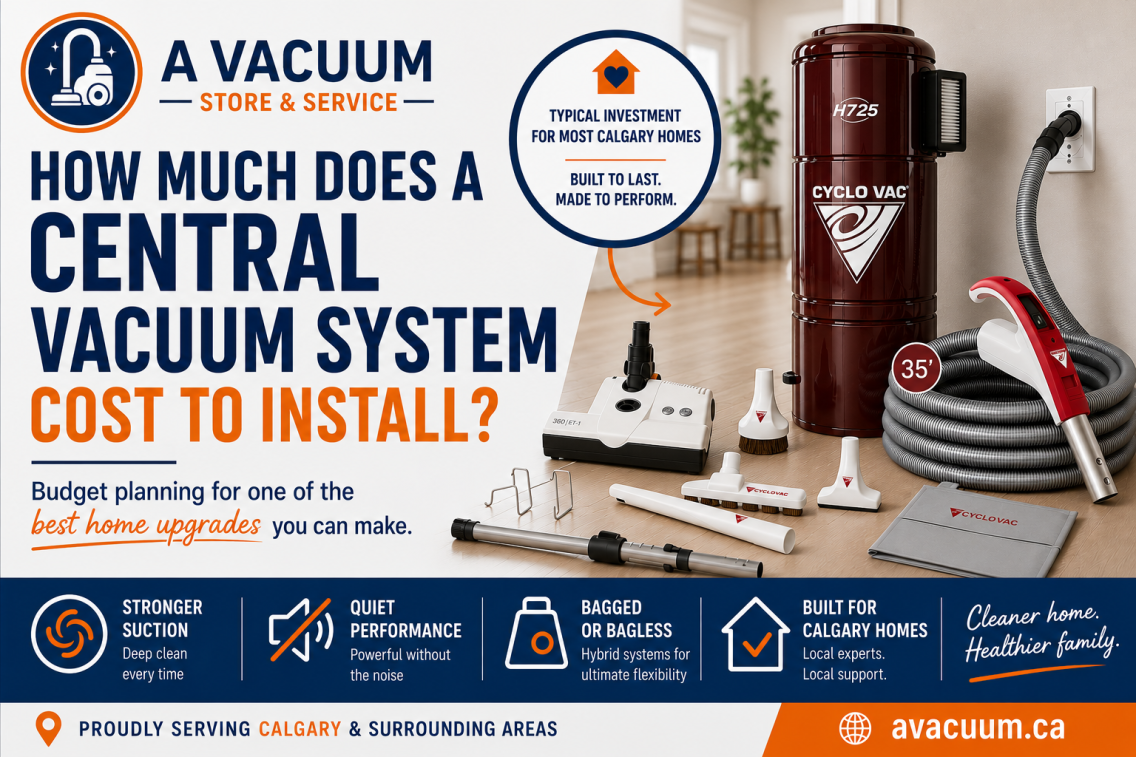
How Much Does a Central Vacuum System Cost to Install?
Budget planning for one of the most convenient home upgrades you can make.
One of the most common questions we get from homeowners is:
The honest answer is: it depends.
The size of your home, whether you're building new or adding a system later, the number of inlets, the quality of the equipment and the features you choose can all affect the final price.
That said, after installing central vacuum systems in Calgary homes for many years, we can give you some realistic numbers and explain where your money is actually going.
What Does a Central Vacuum System Typically Cost?
For most homeowners, a complete central vacuum system including the power unit, installation, attachments and accessories typically falls between $1,500 and $3,500+.
If you're building a new home and installing the piping during construction, costs are generally lower than retrofitting a finished home.
A basic installation in a smaller home may come in around the lower end of that range, while larger homes, luxury homes, retractable hose systems or homes requiring extensive retrofit work can cost considerably more.
What Factors Affect the Price?
Home Size
Larger homes typically require more pipe, more labour and sometimes additional inlets.
However, square footage isn't always the biggest factor. We've installed systems in large homes that were surprisingly straightforward and smaller homes that were more complicated because of layout restrictions.
Number of Inlets
The more inlet locations you need, the more materials and labour are required.
That said, more isn't always better.
One of the most common mistakes we see is homeowners assuming they need an inlet in every room. A properly designed system can often cover large areas with fewer outlets than people expect.
New Construction vs. Retrofit Installation
Installing a central vacuum during construction is almost always the most cost-effective option.
When walls are open, running pipe is quick and straightforward. Once drywall is finished, installation becomes more labour-intensive because technicians need to find creative ways to route pipe through existing walls, ceilings, utility spaces and unfinished areas.
While retrofitting is absolutely possible — and something we do regularly — it generally costs more than installing during construction.
Attachment Package
This is an area where prices can vary dramatically.
Many homeowners focus entirely on the power unit and overlook the attachments they use every day.
In reality, the hose, power nozzle and cleaning tools can have a huge impact on your cleaning experience.
A great canister paired with a poor attachment package can still leave you disappointed with the system.
A quality electric powerhead with height adjustment and a durable hose can make a big difference, especially if you have carpet, pets or a larger home.
Real-World Examples
Example #1: New Construction Family Home
A homeowner building a two-storey family home wanted a complete system installed during construction.
The rough-in was completed while the walls were open, followed by installation of the power unit and attachment package after construction was finished.
Because access was easy during the build process, installation costs remained very reasonable and the homeowner avoided future retrofit expenses.
Example #2: Existing Home Retrofit
A homeowner moved into a home that had never been roughed in for central vacuum.
We were able to retrofit the system using existing utility spaces and strategic pipe routing.
The project took more planning and labour than a new-construction installation, but the homeowner still ended up with a fully integrated system without major renovations.
Example #3: Larger Home with Premium Features
A larger home required additional inlet locations, exterior venting and premium attachments.
While the initial investment was higher, the homeowner wanted a system designed to last for many years with maximum convenience and performance.
Common Budgeting Mistakes
Focusing Only on the Power Unit
Many homeowners shop based solely on motor specifications or air watts.
While performance matters, a central vacuum system is only as good as the tools attached to it.
We've seen homeowners invest heavily in a power unit only to pair it with a lower-quality hose and nozzle package that limits the overall experience.
Choosing the Cheapest Option
A central vacuum system is not something most people replace every few years.
The difference between an entry-level system and a higher-quality system is often relatively small when spread over many years of ownership.
Buying quality once is often less expensive than upgrading everything later.
Not Planning During Construction
Even if you're not ready to purchase the full system, roughing in the piping during construction can save significant labour costs in the future.
It's one of the easiest upgrades to add when the walls are open — and one of the more difficult ones to add later.
Are Upgrades Like VacPans and Exterior Venting Worth It?
In our experience, some upgrades provide excellent value.
Exterior venting is something we recommend whenever possible. It allows the vacuum exhaust to be discharged outside rather than back into the utility area of the home.
VacPans are popular in kitchens, mudrooms and entryways, making it easy to sweep debris directly into the central vacuum system.
Other upgrades depend entirely on your lifestyle and cleaning habits.
What works perfectly for one homeowner may be completely unnecessary for another.
That's why we always recommend designing the system around how you actually use your home.
So, What Should You Budget?
If you're planning for a quality central vacuum system, a realistic budget for many Calgary homeowners is somewhere between $1,500 and $3,500+, depending on the home, installation requirements and equipment selected.
The best approach is to focus on long-term value rather than simply finding the lowest price.
A properly designed central vacuum system can last for many years, make cleaning easier and add convenience you'll appreciate every week.
Thinking About Installing a Central Vacuum?
Whether you're building a new home, renovating or wondering if a retrofit installation is possible, we'd be happy to help.
At A Vacuum Store & Service, we provide free in-home estimates for central vacuum installations in Calgary and can recommend a system that fits both your home and your budget.
We'll explain the options, answer your questions and help you avoid paying for features you don't actually need.
Because the best central vacuum system isn't necessarily the most expensive one — it's the one that's designed properly for your home.
No pressure. No sales pitch. Just 25+ years of real vacuum experience in Calgary.
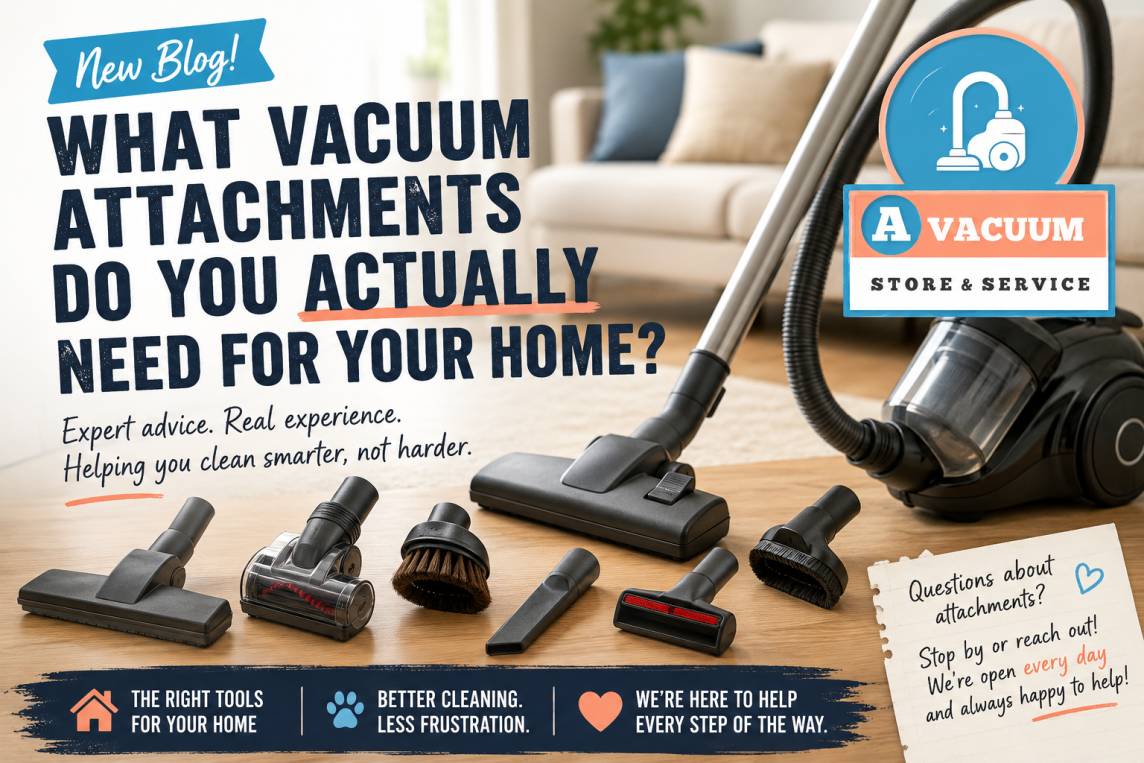
What Vacuum Attachments Do You Actually Need for Your Home?
After more than 25 years selling, repairing and servicing vacuums, here's what we tell customers before they buy another attachment they'll probably lose in the closet.
If you've ever bought a vacuum and opened the box only to discover what feels like 47 mysterious attachments, you're definitely not alone.
One of the most common questions we get in the store is:
And my honest answer is usually the same.
Probably fewer than you think.
People often assume the vacuum with the most attachments must automatically be the best option.
But after years of selling, repairing, installing and servicing vacuums, I can tell you that having more attachments doesn't necessarily mean you'll clean better.
Usually, it just means you have more pieces living in a closet somewhere wondering why nobody loves them.
The reality is that the right attachments depend far more on your home than they do on the vacuum itself.
The first thing I usually ask customers is simple:
"What are you cleaning?"
Because someone living in a condo with mostly hard floors and one area rug needs something completely different than someone with three kids, two dogs, carpet upstairs, stairs everywhere and furniture apparently designed specifically to collect pet hair.
The Most Important Attachment Is Usually the One Under the Vacuum
One thing people often underestimate is how important the right floor attachment actually is.
We regularly see customers frustrated because they feel their vacuum isn't cleaning properly when the real problem is that they simply have the wrong attachment for their flooring.
For carpet, a proper motorized carpet attachment or electric powerhead can make a massive difference.
Carpet fibres trap dirt, hair, dust and debris much deeper than people realize, and suction alone often isn't enough.
This is something we see constantly. Someone upgrades from a basic floor tool to a proper powerhead and suddenly feels like they've discovered an entirely new vacuum.
Same vacuum.
Completely different cleaning experience.
Hard Floors Usually Need Less Than You Think
If your home is mostly hardwood, vinyl, laminate or tile, things can often be much simpler.
You usually don't need an army of specialty tools.
A good hard floor brush or quality combination floor tool often does the majority of the work.
Sometimes homeowners assume they need complicated attachments for every room when really they just need something that glides easily, protects the flooring and actually gets used consistently.
The best attachment isn't always the fanciest one... it's usually the one you reach for every day.
Pet Owners Know Attachments Become a Bigger Conversation
Pet hair is almost impressive in the way it manages to get absolutely everywhere.
Stairs. Furniture. Corners. Baseboards.
Places that scientifically shouldn't even contain hair somehow still do.
For homes with pets, the right upholstery tool, mini powerhead or dedicated pet attachment can completely change how frustrating cleaning feels.
We regularly see customers assume their vacuum is failing when in reality they simply didn't have the right tool for the job.
Sometimes a five-minute attachment change solves what people thought was a vacuum problem.
The Attachment You Ignore Might Become Your Favourite
One thing that surprises many people is that sometimes the attachment they thought was useless becomes the attachment they use constantly.
We've had customers move into homes with awkward stairs, high ceilings, unusual layouts, deep furniture gaps or ventilation systems they suddenly realize need cleaning.
The attachment they originally planned to throw in a drawer suddenly becomes their favourite tool in the entire house.
That's why we're always hesitant to tell someone an attachment is completely unnecessary without first asking about their home.
Close Enough Usually Isn't Close Enough
There's also a mistake we see all the time.
People try forcing the wrong attachment into doing jobs it simply wasn't designed for.
Using carpet tools on hard floors.
Using hard floor brushes on thick carpet.
Dragging one attachment around the entire house because, well... close enough should work.
Sometimes it simply cleans poorly.
Sometimes it becomes frustrating.
And sometimes it can actually create unnecessary wear on your flooring, your carpets or even the vacuum itself.
A vacuum is only as effective as the tool touching the floor.
So What Do You Actually Need?
If there's one piece of advice I would give homeowners, it's this:
Not the attachment with the fanciest marketing.
Not the attachment bundle with 25 pieces.
Not the attachment somebody online swears completely changed their life.
The right attachment setup depends on your flooring, your home layout, your furniture, your pets and honestly... how you clean.
Because after years in this industry, I can confidently tell you that the "perfect" attachment setup for one home can be completely wrong for another.
And that's exactly why when customers ask us what attachments they need, we usually answer with a few questions first instead of immediately pointing at the biggest accessory package.
If you're unsure whether you need a different attachment, are trying to replace one or simply want to know if buying another attachment is even worth it, feel free to stop by the shop or give us a call.
We're open every day and we're always happy to help figure out what actually makes sense for your home.
Even if the answer is... you don't need another attachment at all.
No pressure. No sales pitch. Just 25+ years of real vacuum experience in Calgary.
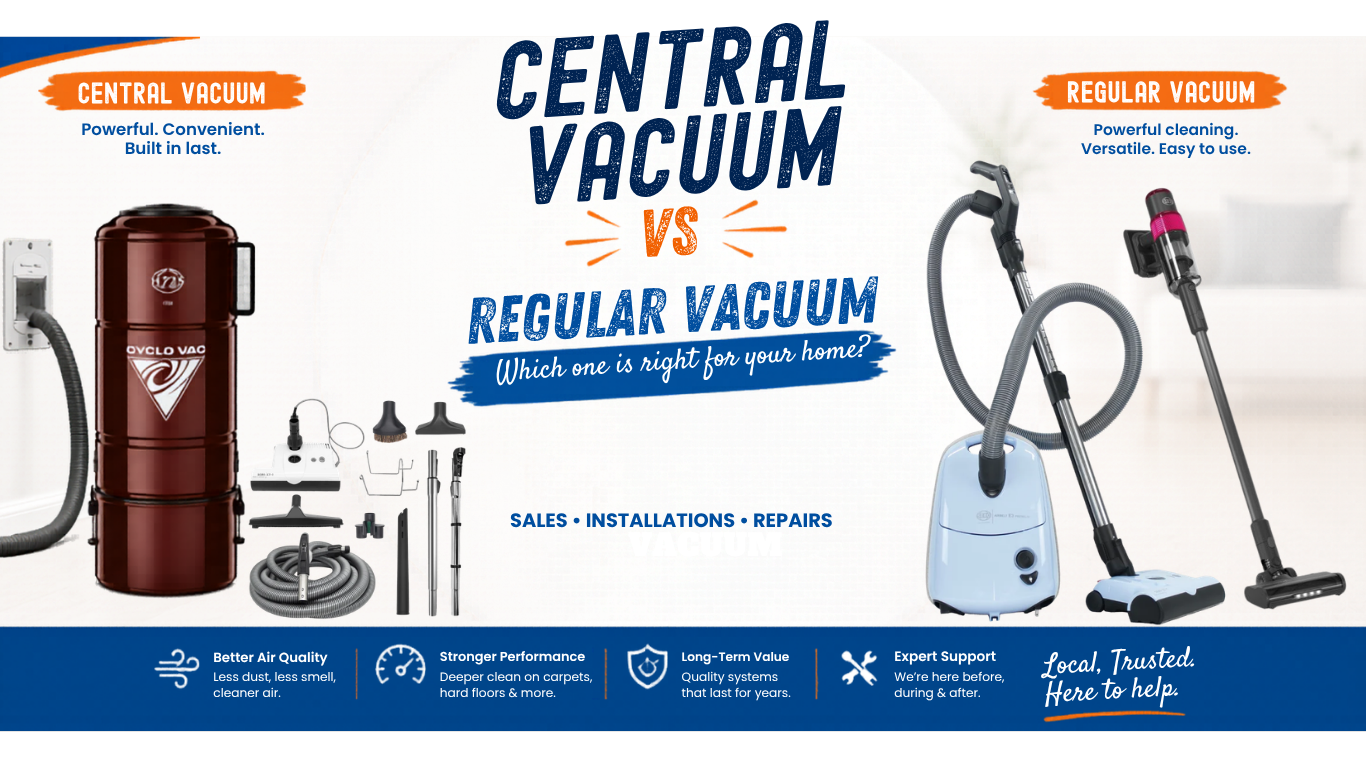
Central Vacuum vs Regular Vacuum: Which One Should You Actually Choose?
After more than 25 years around vacuums, here's what we think actually matters when deciding between a central vacuum and a regular portable vacuum.
If you've been shopping for a vacuum lately, you've probably noticed something: every vacuum claims to be "the best."
One commercial tells you a cordless stick vacuum will completely change your life. Another says robot vacuums are basically tiny cleaning angels roaming your home while you relax on the couch.
Then there's the "pet vacuum," the "max power vacuum," the "extreme suction vacuum," and whatever other marketing phrase somebody came up with in a boardroom after three coffees and a PowerPoint presentation.
Meanwhile, most people are just trying to keep their floors clean without fighting with their vacuum every weekend.
At A Vacuum Store & Service, one of the most common questions we get is:
After years in the industry, the answer isn't nearly as black and white as people think.
The best vacuum depends entirely on your home, your lifestyle, your floors, your patience level and sometimes even your personality.
We've had customers absolutely fall in love with central vacuums after years of hating vacuuming, and we've also had customers with beautiful central vacuum systems realize they simply preferred using a high-quality portable vacuum instead.
That's why I think a lot of the advice online misses the mark.
Somebody living in a downtown condo with hardwood floors and no pets has completely different cleaning needs than a family with two kids, three cats, a Golden Retriever and beige carpet throughout the entire house.
Those are not the same vacuuming situations. Not even close.
Modern Central Vacuums Aren't What Many People Remember
One of the biggest misconceptions we hear about central vacuums is that they're bulky, heavy, awkward and outdated.
Usually that opinion comes from somebody who remembers using one at their parents' house twenty years ago, or somebody who moved into a home with an old system and terrible attachments.
And to be fair, older systems could absolutely feel clunky. The hoses were heavier, the accessories were bulky and some setups honestly performed terribly.
But modern central vacuum systems are a completely different experience.
Today's hoses are much lighter, they swivel naturally at the handle and the overall ergonomics are far better than people expect.
A lot of customers are surprised the first time they try a modern central vacuum because they realize they're not dragging around the weight of a vacuum motor at all.
People also get hung up on the idea of the hose being "so long," but they forget that the hose replaces both the vacuum body and the power cord.
Instead of unplugging room to room or running out of battery halfway through cleaning, you plug into one inlet and clean large sections of the house without interruption.
Where Central Vacuums Really Shine
Central vacuums can be fantastic in busy homes.
If you have pets, kids, lots of carpet or just a high-traffic home where dirt constantly seems to appear out of nowhere, the larger capacity alone can make a huge difference.
You're no longer stopping every few minutes to empty a tiny dust bin or clean filters packed with pet hair.
Central systems are designed to handle larger amounts of dirt and debris over time, which matters a lot in real-life cleaning.
And Then There's the Exhaust
Another thing customers often notice is the difference in where the dirt, motor and exhaust are located.
A properly installed central vacuum separates the motor and dirt collection from the main living space, and many systems can vent the exhaust outside entirely.
We've also had customers concerned about dust and allergies tell us they preferred the experience after switching away from certain bagless portable systems.
That doesn't mean a central vacuum is automatically the right answer for every home, but having the collected dirt and potentially the exhaust away from your main living area is certainly one of the reasons many homeowners choose them.
But Some People Simply Prefer a Portable Vacuum
With all that being said, I still don't think central vacuums are automatically the right fit for everyone.
Sometimes people simply prefer the feel of a portable vacuum, and that's perfectly fine.
We've had customers who owned perfectly good central vacuum systems but just didn't enjoy using that style of vacuum.
It wasn't a performance problem. They simply liked the convenience and feel of a high-quality portable canister vacuum better.
Because at the end of the day, if you hate using your vacuum, you're probably not going to use it very often.
Where Cordless Stick Vacuums Fit In
Cordless stick vacuums are another huge category right now, and I completely understand why people like them.
They're convenient for quick cleanups. They're great for crumbs in the kitchen, touchups before company comes over or cleaning up after dinner.
Personally, I think cordless stick vacuums work best as what I call a "vacuum assistant" rather than necessarily being the main cleaning machine for a larger home.
That's where I think marketing and reality start separating a little bit.
A lot of stick vacuums advertise impressive battery runtimes, but that timing is often based on lower power settings.
And realistically, if you're vacuuming your house for forty-five minutes or an hour with a tiny cordless vacuum, you're probably also stopping to empty the bin, clean filters, untangle hair or recharge batteries.
I always tell customers that if you're regularly using your stick vacuum for more than five or seven minutes, that job was probably meant for a proper plug-in vacuum.
Why I'm Still Not a Huge Fan of Bagless
Bagless vacuums are another area where my opinion tends to differ from the marketing.
Personally, I'm not a fan of them.
They're constantly advertised as low maintenance, but in real life they often require far more maintenance than people expect.
You're cleaning filters, washing cyclones, unclogging chambers and dealing with dust clouds every time you empty them.
I'm not interested in cleaning the vacuum and then cleaning the vacuum again afterward.
A good bagged vacuum system is cleaner to empty, easier to maintain and generally much better at keeping the collected dirt contained.
And What About Robot Vacuums?
Robot vacuums might be the most polarizing category of all.
Some people absolutely love them. Others buy one, use it twice and then park it permanently under the couch.
I think they can be useful in certain homes.
Some seniors appreciate having something help maintain the floors between deeper cleanings, and homes with lots of pet hair may like having something automatically picking up surface debris every day.
But despite what the commercials show, robot vacuums are not deep-cleaning machines.
They can't clean stairs. They can't properly clean furniture. And they definitely can't replace everything a good upright, canister or central vacuum can do.
And I'll admit, I'm especially not sold on the robot vacuum-and-mop combinations.
The idea of vacuuming dirt and then immediately creating muddy floor soup just doesn't personally appeal to me.
Don't Buy a Vacuum Based on Marketing
One of the biggest mistakes customers make when buying a vacuum is focusing almost entirely on marketing.
They buy based on hype, a TikTok video or because a friend recommended a certain model.
But every home is different.
A vacuum that works beautifully for somebody living in a condo with hard floors might be completely wrong for a two-storey family home full of carpet and pet hair.
The goal should never be buying the most popular vacuum. The goal is buying the right vacuum for your home.
It's About More Than "Strong Suction"
I also think people misunderstand what actually makes a vacuum clean well.
It's not just about "strong suction" or flashy buzzwords like "pet edition" or "extreme power."
A properly designed vacuum should already handle pet hair well.
What matters more is airflow, brush roller design, filtration, carpet height adjustment and the quality of the attachments.
With central vacuums especially, people often focus heavily on air watts because that's what gets advertised, while water lift is another specification that can be important when looking at cleaning performance.
What Customers Actually Notice
One thing customers consistently tell us after upgrading to a good vacuum — whether it's a central vacuum or a high-quality portable vacuum — is that cleaning simply becomes less frustrating.
They notice easier maintenance, cleaner carpets and an overall better cleaning experience.
Funny enough, most customers don't come back talking about technical specifications.
They come back saying things like: "My house finally feels clean."
Or: "I don't dread vacuuming anymore."
And really, that's what it comes down to.
Nobody loves cleaning. Vacuuming probably isn't going to become your favourite hobby overnight.
But a good vacuum should make the job easier, faster, cleaner and less annoying.
So Which One Should You Choose?
After years in the industry, my personal opinion is that central vacuums are absolutely worth it for many homes.
They've been around for decades for a reason. They're powerful, long-lasting and genuinely practical, especially for larger homes and busy households.
At the same time, high-quality portable vacuums can also be fantastic options when they're matched properly to the customer and the space.
The key word there is high-quality.
Not trendy.
Not viral.
Not heavily advertised.
Just genuinely well-built.
Because often the best vacuum brands are the ones investing more into engineering the product than into convincing you on social media that your current vacuum is ruining your life.
The best vacuum isn't the one with the best commercial. It's the one that makes sense for your home and that you'll actually enjoy using.
No pressure. No sales pitch. Just 25+ years of real vacuum experience in Calgary.
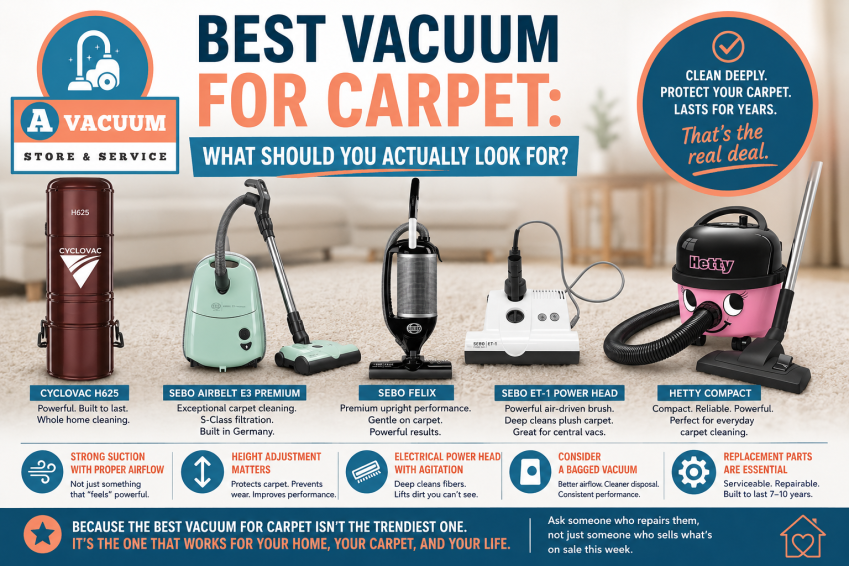
Best Vacuum for Carpet: What Should You Actually Look For?
After more than 25 years selling and repairing vacuums, here's what we look for when someone wants a vacuum that actually cleans carpet properly.
If you're trying to find the best vacuum for carpet, you've probably noticed something...
Every brand claims "max power."
Every box promises "deep clean."
And somehow every second vacuum seems to be a "pet vacuum."
Yet we constantly see people walk into our store frustrated because their new vacuum isn't actually cleaning their carpet properly.
After years of working with vacuums in Calgary homes — especially homes with plush carpet and pets — I can tell you this:
Strong Suction Isn't the Same as Good Carpet Cleaning
One of the biggest misconceptions when choosing a vacuum for carpet is that stronger suction automatically means better carpet cleaning.
People often test a vacuum by putting their hand over the end of the hose. If it feels strong, they assume it must clean well.
But carpet cleaning involves more than how much pull you feel at the hose.
What really matters is the combination of airflow, suction and proper agitation at the carpet.
The vacuum needs enough airflow to carry loosened dirt away while the brush roller works through the carpet fibres and releases embedded debris.
A vacuum can feel powerful at the hose and still leave sand, hair and grit buried in the carpet.
Why Height Adjustment Matters
If you're shopping for a vacuum for plush or thicker carpet, height adjustment is one feature we pay very close attention to.
The brush roller needs to make proper contact with the carpet without burying itself too deeply into the pile.
If the nozzle sits too low, the vacuum can become difficult to push, airflow can be restricted and the brush roller or belt may be put under unnecessary strain.
If it sits too high, the brush may barely contact the carpet at all.
Different carpets need different settings. One fixed height doesn't work perfectly for everything.
A properly adjusted carpet nozzle lets the brush roller work through the fibres while maintaining enough airflow for effective cleaning.
"Pet Vacuum" Is Mostly a Marketing Term
If you're looking for the best vacuum for carpet with pets, don't get too distracted by the word "pet" printed on the box.
Pet hair doesn't require magical technology.
It requires a well-designed brush roller, good airflow and enough agitation to pull hair out of the carpet fibres.
For homes with wall-to-wall carpet, we generally prefer a proper motorized carpet nozzle or electric powerhead rather than relying only on an air-driven turbo brush.
An electric powerhead has its own motor driving the brush roller, so the brush speed remains much more consistent as you move across the carpet.
When you're dealing with carpet and pet hair, consistent agitation makes a huge difference.
Don't Forget About the Brush Roller
The brush roller is doing a lot of the heavy lifting on carpet, so we also look at how easy it is to maintain.
Long hair, pet hair and fibres naturally wrap around the brush over time.
A removable or easily accessible brush roller makes regular cleaning much easier and helps prevent hair from building up around the bearings and ends of the brush.
It's a small design detail that can make a big difference over years of ownership.
Replacement Parts Matter More Than People Think
When people are deciding how to choose a vacuum for carpet, they usually look at price, brand name and specifications.
Almost nobody asks:
"Can this vacuum actually be repaired?"
We regularly see vacuums — including some fairly expensive ones — that become difficult or uneconomical to repair because replacement parts simply aren't available.
And carpet vacuums have working components that naturally wear over time.
Belts wear. Brush rollers eventually wear down. Wheels and housings can break. Motors and electrical components can fail.
That doesn't automatically mean the vacuum is finished.
At least, it shouldn't — if the machine was designed to be serviced.
A quality carpet vacuum with good parts availability can often be maintained and repaired for many years instead of being replaced every time something wears out.
Bagged vs. Bagless for Carpet
Bagless vacuums are extremely popular, but for homes with lots of carpet — especially homes with pets — I often prefer a good bagged vacuum.
Carpet produces a surprising amount of fine dust, fibres and pet dander.
Modern high-quality vacuum bags provide a large filtration surface while containing all of that debris inside the bag.
When the bag is full, you take it out and replace it.
Bagless vacuums rely more heavily on their filters and cyclonic system, which means those components need to be kept clean for the vacuum to continue performing properly.
And after years behind the counter, I can tell you: most people do not clean their vacuum filters as often as the manufacturer recommends.
So What Is the Best Vacuum for Carpet?
If someone walked into the store today and asked me directly, here's what I would tell them.
Look for a vacuum with good airflow and enough suction to move debris effectively.
For wall-to-wall carpet, choose a proper motorized carpet nozzle or electric powerhead.
If you have plush or varied carpet heights, look for height adjustment.
Make sure the brush roller can be cleaned easily.
Consider a quality bagged system if you want cleaner disposal and simpler filtration maintenance.
And always find out whether replacement parts are actually available.
Because a good carpet vacuum shouldn't just clean well on day one. It should still be worth owning years later.
Your Carpet Matters Too
One thing people sometimes forget is that there isn't one perfect vacuum setting or brush design for every carpet.
Low-pile carpet, dense carpet, plush carpet, wool carpet and very high-pile carpet can all behave differently.
That's why we always recommend considering the carpet itself rather than buying purely from a vacuum specification sheet.
If your vacuum is extremely difficult to push, the brush roller constantly bogs down, belts keep failing or the carpet seems to be getting aggressively pulled at, something isn't right.
It may not mean you need "more suction."
You may simply have the wrong vacuum or nozzle for that carpet.
Carpet is expensive. Replacing it isn't cheap.
The best vacuum for carpet is the one that cleans it properly while also being appropriate for the flooring you're trying to protect.
If you're unsure whether your current vacuum is right for your carpet, stop by the store, bring your questions or even bring your vacuum in and let us take a look.
Because when it comes to carpet, good design matters a lot more than good marketing.
No pressure. No sales pitch. Just 25+ years of real vacuum experience in Calgary.

Why Buying From a Local Vacuum Store Beats Big Box Retail
Buying a vacuum is easy. Getting the right one, keeping it running properly, and having somewhere to turn when something goes wrong is where the real value begins.
If you've ever walked into a big box store looking for a vacuum, you know how it goes.
Aisles of machines, all claiming to be powerful, advanced and "the best choice for your home."
On the surface, it feels simple enough.
Pick one. Pay for it. And you're done.
Except a vacuum isn't really a one-time purchase.
It's something you rely on week after week, and eventually it's going to need attention.
And that's usually where the difference between a big box retailer and a local vacuum store really starts to show.
The Relationship Doesn't End at Checkout
When you buy from a big box retailer, the relationship usually ends when you leave the store.
If something goes wrong later, you're often left figuring it out yourself — whether that means digging through warranty information, watching videos online or simply replacing the machine altogether.
Most of the time, there's nobody there who can actually open the vacuum up, inspect it and tell you what's really going on.
A local vacuum store is a very different experience.
You're not just buying a product. You're also getting somewhere to bring it back when it stops working the way it should.
A Vacuum That "Died" Might Not Be Dead at All
More often than people think, it's not the vacuum that's finished.
It might be a clogged filter.
A brush roller packed with hair and debris.
A worn belt.
Or a hidden blockage that has slowly been reducing airflow and suction over time.
These are the kinds of issues that make people assume they need a new machine when, in reality, proper vacuum service may be all it needs.
That's something people don't always realize: vacuums don't necessarily fail overnight.
Performance can slowly drop. The machine gets louder. Suction seems weaker. It becomes harder to push. Maybe it starts smelling a little different.
When you use it every week, you can get used to it getting worse without really noticing.
Sometimes the Right Answer Is a Repair
There's also something important about getting advice from people who actually work on vacuums every day.
The answer doesn't always have to be: "Buy a new one."
Sometimes the right answer is a repair.
Sometimes it's a proper cleaning and service.
Sometimes it needs a new brush roller, belt, hose, filter or another replaceable part.
And yes, sometimes replacement really does make more sense.
The important part is knowing which situation you're actually dealing with.
That advice means a lot more when it's coming from someone who sees what actually fails, what lasts, what can be repaired and what isn't worth putting more money into.
Choosing the Right Vacuum Matters Too
The difference starts before the vacuum ever needs service.
At a local vacuum store, we can ask questions about your home before recommending anything.
Do you have carpet or mostly hard floors?
Pets? Stairs? Area rugs? Long hair? A large house? A condo?
Do you want something lightweight, or are you more concerned about deep carpet cleaning?
Those things matter far more than whatever feature happens to be printed in the biggest letters on the box.
The goal isn't to sell you the vacuum with the most features. It's to help you choose one that makes sense for your home.
And Then There's Parts and Long-Term Support
One thing many people don't think about when buying a vacuum is what happens two, five or ten years later.
Can you get bags?
Filters?
Belts?
A replacement hose?
A brush roller?
Can the machine actually be opened, serviced and repaired?
Those aren't very exciting questions when you're standing in a store looking at a brand-new vacuum.
But a few years later, they can become the most important questions of all.
Supporting Local Service Matters
There's also a bigger picture.
Local businesses support local jobs, local skills and local service.
When you choose to buy locally or repair something instead of immediately replacing it, you're also helping keep that knowledge and service available in the community.
At A Vacuum Store & Service, that's really what we focus on.
Not just selling vacuums, but helping keep them working properly for as long as it makes sense.
Whether it's a stick vacuum, upright, canister, handheld or central vacuum system, the goal is the same.
Keep it cleaning properly. Keep it running as long as possible.
The Real Value Comes After the Sale
Buying a vacuum isn't really the hard part.
There are plenty of places willing to sell you one.
The real question is what happens afterward.
Who helps when it loses suction?
Who helps you find the right replacement part?
Who tells you when a repair is worth doing — and when it isn't?
That's where buying from a local vacuum store really makes a difference.
Because the real value isn't just buying the vacuum. It's having someone there to help you keep it working.
No pressure. No sales pitch. Just 25+ years of real vacuum experience in Calgary.
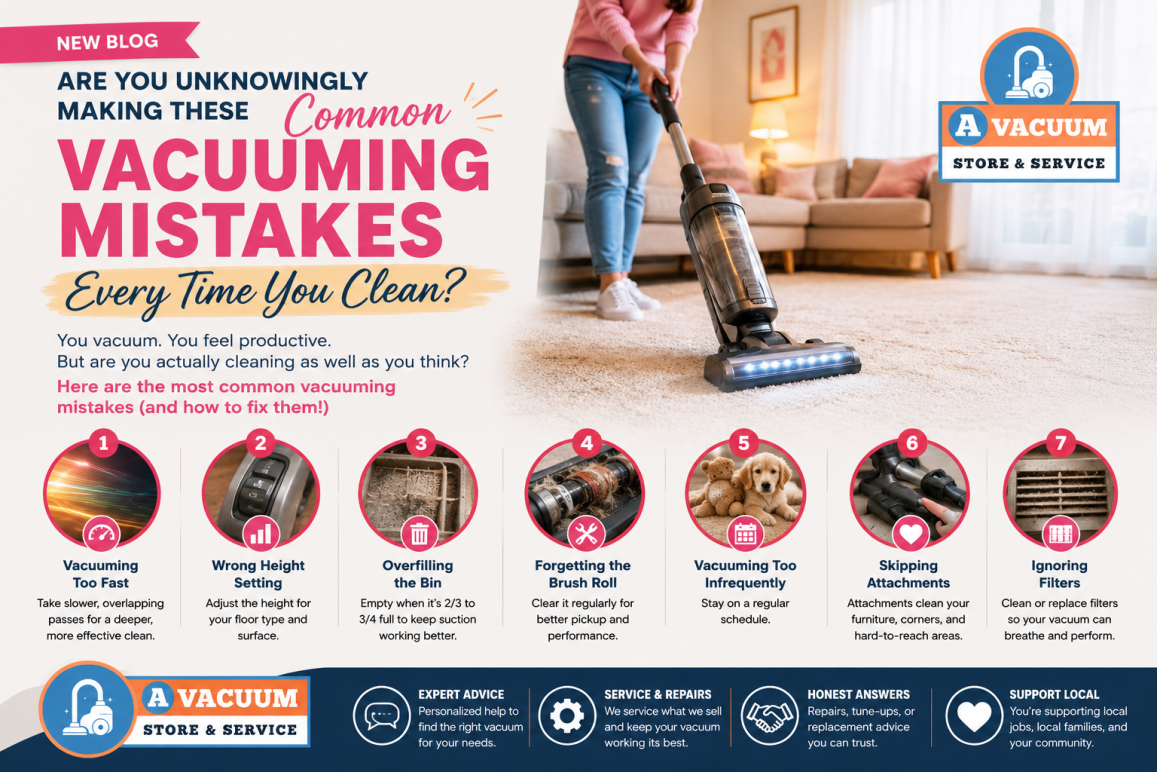
Are You Unknowingly Making These Common Vacuuming Mistakes Every Time You Clean?
After more than 25 years selling and repairing vacuums, we've learned that a few small cleaning habits can make a surprisingly big difference.
Yes, most people are probably making at least one or two vacuuming mistakes without even realizing it.
And the frustrating part is that those habits don't just leave dirt behind — they can also make the vacuum work harder and reduce performance over time.
Vacuuming too quickly, using the wrong settings, ignoring filters or letting hair completely take over the brush roller can all make cleaning far less effective than it should be.
Let's set the scene.
You vacuum. You feel accomplished. The carpet lines are crisp, the room looks clean and for one brief shining moment you believe you've officially won at adulthood.
But here's the slightly dramatic plot twist: you might be quietly sabotaging your own clean.
Mistake #1: Treating Vacuuming Like a Cardio Workout
We all do it.
We zoom back and forth across the carpet like we're late for something.
The problem is that the brush roller and airflow need a little time to actually loosen and remove dirt from the carpet.
If you race across the room, you're more likely to skim over the surface rather than give the vacuum time to work through the fibres.
Slowing down — sometimes painfully slow — can make a noticeable difference.
It may feel less efficient, but you're often getting much more out of each pass.
Mistake #2: Never Adjusting the Height Setting
Different carpet types need different clearance levels, yet a lot of people set the vacuum height once and never touch it again.
If the setting is too low on plush carpet, the nozzle can seal too tightly to the floor, restrict airflow and make the vacuum difficult to push.
If it's too high on lower-pile carpet, the brush roller may barely make contact with the fibres at all.
Your floors aren't one-size-fits-all. Your vacuum setting shouldn't be either.
Mistake #3: Waiting Until the Dust Bin Is Packed
If you use a bagless vacuum, waiting until the dust bin is packed to the top may feel efficient.
Unfortunately, many bagless machines start losing effective airflow before the container looks completely full.
Fine dust, pet hair and debris can begin interfering with the cyclonic system and filters long before the bin looks dramatic enough to empty.
Following the manufacturer's fill line and emptying the bin before it's overfilled can help keep the machine working properly.
Mistake #4: Forgetting the Filters Exist
Filters are one of those vacuum parts people tend to forget about until something starts smelling strange or the suction suddenly seems terrible.
They help trap fine dust before it can travel through parts of the machine where you don't want it.
But when filters become clogged, airflow can drop and the motor may have to work harder.
Check them regularly and follow the manufacturer's cleaning or replacement instructions.
And if the filter is washable, let it dry completely before putting it back in.
Mistake #5: Ignoring the Brush Roller
Flip your vacuum over sometime and you may discover something that looks like the brush roller has been through a battle.
Hair, thread, string and fibres can wrap tightly around it over time.
When the brush can't spin freely, agitation drops and the belt, bearings or brush motor can be put under extra strain.
A quick check every few weeks — especially in homes with pets or long hair — can prevent a much bigger mess later.
Sometimes your vacuum doesn't need more suction. It just needs the hair removed from the brush.
Mistake #6: Waiting Until the Floor Looks Dirty
Another common mistake is waiting until you can actually see dirt before vacuuming.
By the time debris is obvious on carpet, there's usually already plenty of fine dust and grit sitting deeper in the fibres.
Regular vacuuming helps remove that abrasive soil before it continues being walked deeper into the carpet.
It's less about reacting to a visible mess and more about preventing buildup before it becomes one.
Mistake #7: Assuming Every Vacuum Needs the Same Maintenance
The type of vacuum you're using matters more than people sometimes realize.
Bagless vacuums rely heavily on cyclones and filters, so they generally need more hands-on filter and bin maintenance to keep airflow consistent.
A quality bagged vacuum contains debris inside the bag and can make routine maintenance and disposal much cleaner.
Central vacuum systems are different again because the motor and dirt container are located away from the main living space, often in a garage, basement or utility area.
They also usually have much larger dirt capacity than portable vacuums, which means you're not constantly emptying a small bin.
Different designs have different maintenance needs — but none of them are truly maintenance-free.
Mistake #8: Assuming the Vacuum Will Tell You When It Needs Service
Vacuums need maintenance too.
Belts stretch. Brush rollers wear. Filters clog. Hair gets into places hair somehow always manages to get into.
And internal dust can accumulate in areas you'll probably never see without taking the machine apart.
The tricky part is that performance often declines gradually.
You don't necessarily wake up one morning and suddenly have half the suction you had yesterday.
Instead, the vacuum slowly gets worse and you slowly get used to it.
Until one day you realize: "Was this vacuum always this bad?"
Periodic service can catch worn parts, hidden clogs and airflow problems before they turn into larger repairs.
Good Vacuuming Is More Than Just Going Back and Forth
Good cleaning comes from several things working together.
Airflow.
Brush agitation.
Proper filtration.
The right floor setting.
And regular maintenance.
You don't need to completely reinvent the way you clean.
A few small adjustments can make your vacuum work better and make the whole job a lot less frustrating.
So the next time you vacuum, slow down a little.
Check the setting. Empty the bin. Look at the filter. Give the brush roller some attention.
Because when it comes to vacuuming, cleaning smarter really is better than cleaning harder.
No pressure. No sales pitch. Just 25+ years of real vacuum experience in Calgary.
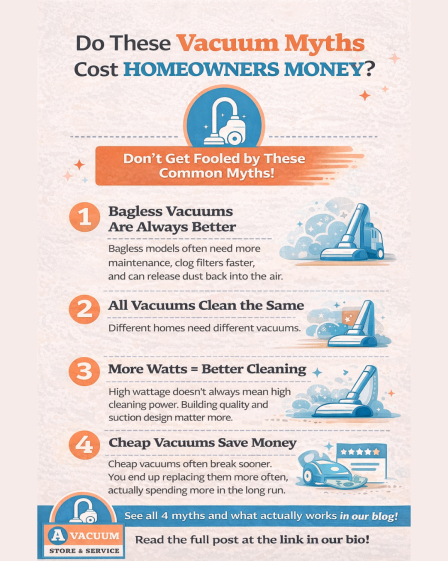
The Biggest Vacuum Myths That Cost Homeowners Money
After more than 25 years selling and repairing vacuums, we've heard just about every piece of vacuum advice imaginable. Some of it is useful. Some of it... not so much.
There's certainly no shortage of vacuum advice online.
A quick search will give you hundreds of articles, videos and "Top 10 Vacuum" lists promising to reveal the best machine on the market.
But after working with vacuums every day and helping homeowners figure out what actually works in their homes, we've noticed something interesting.
A lot of the most common things people believe about vacuums simply aren't true.
And some of those myths can end up costing you money — whether that's buying the wrong vacuum, replacing one unnecessarily or paying for features that don't actually matter for your home.
So let's clear up a few of the ones we hear all the time.
Myth #1: Bagless Vacuums Are Always Better
This is probably one of the most common beliefs we hear.
The idea makes sense at first.
No bags to buy. No bags to change. Just empty the bin and keep going.
Sounds easier.
But "bagless" doesn't necessarily mean maintenance-free.
Bagless vacuums rely heavily on their cyclonic system and filters. Dust bins need to be emptied regularly, filters need cleaning or replacement, and fine dust can escape back into the room when the bin is emptied.
Modern high-quality vacuum bags are very different from the simple paper bags people may remember from decades ago.
Many are made from multiple layers of filtration material that trap fine dust while allowing air to continue moving through the vacuum.
And when it's time to empty the vacuum?
You remove the bag and throw it away. The dirt stays inside.
Bagless vacuums can absolutely work well, but they're not automatically cleaner, easier or better simply because they don't use bags.
Myth #2: All Vacuums Basically Clean the Same
At first glance, many vacuums look pretty similar.
Motor. Hose. Brush. Wheels.
How different could they really be?
Quite different, actually.
A vacuum that works beautifully in a small condo with mostly hardwood floors may be completely wrong for a larger home with wall-to-wall carpet.
A home with pets may benefit from a good motorized brush roller and attachments designed to remove hair from carpet and upholstery.
Someone concerned about dust and allergens may care much more about high-quality filtration and how well the entire vacuum is sealed.
And someone with stairs may care more about weight and manoeuvrability than somebody living in a bungalow.
Your flooring, home layout, pets and cleaning habits matter far more than whatever happens to be trending online this week.
Myth #3: Higher Wattage Means More Cleaning Power
This one causes a lot of confusion.
People see a bigger wattage number and naturally assume they're getting a more powerful vacuum.
But wattage primarily tells you how much electrical power the machine consumes.
It doesn't tell you, by itself, how well that vacuum will clean your carpet or floors.
Vacuum performance comes from several things working together — suction, airflow, nozzle design, brush agitation, filtration and how efficiently the entire machine is designed.
Specifications such as water lift can tell us something about the vacuum's ability to create suction, while airflow tells us about the volume of air being moved.
But neither number should really be looked at completely on its own.
A bigger number on the box doesn't automatically mean cleaner floors.
A well-designed vacuum with the right floor tool can outperform a poorly designed machine that looks much more impressive on a specification sheet.
Myth #4: Buying a Cheap Vacuum Always Saves Money
There's absolutely nothing wrong with shopping within a budget.
And spending more doesn't automatically guarantee you're buying a better vacuum.
But price alone can be misleading.
One of the things we've learned from repairing vacuums is that the purchase price is only one part of what a machine actually costs to own.
Can you get replacement parts?
Can the brush roller be replaced?
Can the hose be replaced?
Are filters reasonably priced?
Can the vacuum actually be repaired when something eventually wears out?
A less expensive vacuum that gets replaced repeatedly can ultimately cost more than buying a well-built, serviceable machine and maintaining it.
The better question isn't always: "How much does it cost today?"
Sometimes it's: "How much will this cost me to own?"
Myth #5: Online Reviews Will Tell You Which Vacuum to Buy
Online reviews can be incredibly useful.
But they don't know your house.
The person giving a vacuum five stars may live in a 700-square-foot condo with hard floors.
You may live in a two-storey house with three bedrooms of carpet, stairs, two dogs and enough pet hair to build another dog by Friday.
Same vacuum.
Completely different cleaning situation.
Reviews can tell you about people's experiences with a product, but they can't automatically tell you whether that product is the right match for your flooring, home size, pets, cleaning habits or expectations.
That's why we've had customers come into the store frustrated with vacuums that had fantastic reviews.
Sometimes there was nothing technically wrong with the vacuum.
It was simply the wrong vacuum for their home.
So What Should You Actually Look For?
When customers come into A Vacuum Store & Service in Calgary, we usually start with questions rather than immediately showing them a vacuum.
What kind of flooring do you have?
Do you have pets?
Mostly carpet? Mostly hard floors? A mixture?
Do you have stairs?
Is weight important?
Are you looking for something for quick cleaning or something to deep-clean the entire house?
And yes, there are usually a few more questions once we get talking.
From there, we can compare different options and let customers actually see and try machines rather than choosing entirely from a box or an online description.
Sometimes the vacuum someone walks in planning to buy isn't the one they end up liking at all.
And that's perfectly okay.
The goal isn't to send someone home with the trendiest vacuum.
It's to help them find something that actually makes sense for the way they clean.
And Don't Assume You Need a New Vacuum
There's one more myth worth mentioning.
If your current vacuum isn't working the way it used to, that doesn't automatically mean it's time to replace it.
Sometimes the problem is a clogged hose, dirty filter, worn belt, brush roller packed with hair or another repairable issue.
Other times, replacement really does make more sense.
That's why having the machine looked at before assuming it's finished can sometimes save you quite a bit of money.
After more than 25 years around vacuums, one thing we've learned is that the biggest number, biggest marketing campaign and biggest collection of five-star reviews don't necessarily tell you which vacuum is right for you.
Good design matters. Proper maintenance matters. Repairability matters. And matching the vacuum to the home matters.
Because the best vacuum isn't necessarily the one everybody is talking about. It's the one that works well in your home for years.
No pressure. No sales pitch. Just 25+ years of real vacuum experience in Calgary.
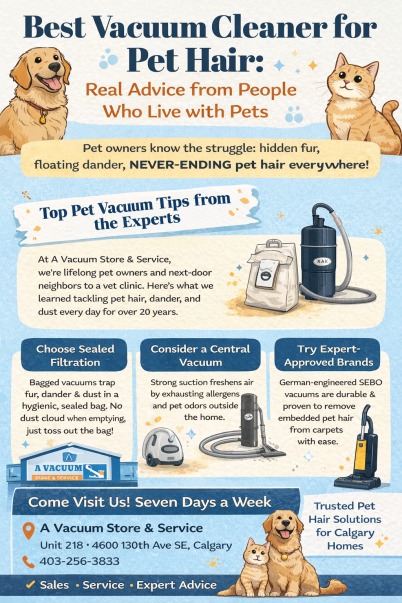
Best Vacuum Cleaner for Pet Hair: Real Advice From People Who Live With Pets
After more than 25 years selling and repairing vacuums — and a lifetime of owning dogs ourselves — we've learned a few things about what actually works when pet hair takes over the house.
If you have pets, you already know the truth: pet hair somehow always finds a way to make a comeback.
It clings to carpets, works its way into furniture, collects along baseboards and somehow appears in rooms you're fairly certain the dog hasn't even been in.
At some point, pet hair stops feeling like a cleaning problem and starts feeling like a decorating choice you never agreed to.
So what is actually the best vacuum for pet hair?
The answer isn't necessarily the vacuum with a picture of a Golden Retriever on the box or the word "PET" written across it in giant letters.
It's about choosing a vacuum with the right combination of airflow, brush agitation, filtration, attachments and ease of maintenance for your home.
We've Been Living With This Problem for a Long Time
At A Vacuum Store & Service, pet hair isn't exactly a new subject for us.
We've owned dogs our entire lives, and our shop has been located next to a veterinary clinic for almost 20 years.
Needless to say, we talk to a lot of pet owners.
We've seen homes with one small dog that barely sheds and homes with multiple pets where you could probably vacuum twice a day and still find another tumbleweed of fur rolling across the floor by dinner.
Pet Hair on Carpet Needs More Than Suction
One of the biggest misconceptions we hear is: "I just need really strong suction."
Strong suction and good airflow certainly matter, but carpet adds another part to the equation.
Pet hair doesn't politely sit on top of the carpet waiting to be vacuumed.
It works its way between the fibres and gets pushed deeper every time somebody walks across the room.
That's where a good motorized brush roller or electric powerhead makes such a difference. The brush agitates the carpet and helps loosen embedded hair so the vacuum can actually carry it away.
On carpet, suction matters. But the brush roller is doing a lot of the heavy lifting.
About Those "Tangle-Free" Brush Rolls...
Pet owners understandably love the idea of a brush roller that never needs cleaning.
So do we.
Unfortunately, we'd still recommend checking the brush roller regularly no matter what the marketing says.
Pet hair, long human hair, thread and fibres have an impressive ability to find their way around brush rollers, end caps and bearings.
Some designs handle hair better than others, but no brush roller should be treated as completely maintenance-free.
If you live with heavy shedders, an easy-to-clean brush roller is worth its weight in gold.
Filtration Matters in a Pet Home
Hair is the part you can see.
Pet homes also deal with dander, fine dust and all the dirt pets happily bring inside with them.
That's one reason we're big fans of quality bagged vacuum systems.
Modern high-filtration bags can capture a large amount of fine debris while keeping it contained inside the vacuum.
And when the bag is full, you remove it and throw it away.
No dumping a dusty bin into the garbage and then watching half of it float back toward you.
For pet owners who are particularly concerned about fine dust and allergens, filtration should be considered as part of the entire vacuum design — not simply whether the word "HEPA" appears somewhere on the box.
Central Vacuums Can Be Fantastic for Pet Owners
For larger homes, multiple-pet households or serious shedders, a central vacuum system can be an excellent option.
One of the biggest advantages is capacity.
Instead of constantly emptying a small dust bin filled with pet hair, you're collecting debris in a much larger container or bag located away from the main living space.
The motor is also located away from where you're cleaning, which makes central vacuums much quieter in the rooms you're actually vacuuming.
And when a central vacuum is vented outdoors, the vacuum's exhaust is discharged outside rather than back into the living area.
For a busy home full of pets, that combination can make everyday cleaning much easier.
What About a Portable Vacuum?
Not every home has or needs a central vacuum.
For a portable vacuum, we look for many of the same things: strong overall airflow, good filtration, a properly designed motorized carpet nozzle, useful attachments and parts that can actually be replaced when they wear.
One option we regularly recommend for pet homes is a SEBO vacuum paired with the ET-1 electric powerhead.
The ET-1's motorized brush roller works extremely well for lifting hair from carpet, and the brush can be removed easily for cleaning — something pet owners tend to appreciate very quickly.
Combined with SEBO's bagged filtration system and serviceable design, it's a setup that makes a lot of sense for homes with carpet and pets.
But that doesn't mean it's automatically the right vacuum for every pet owner.
The right choice still depends on your flooring, your pets and how you actually clean.
Don't Forget the Furniture
Of course, pets rarely have the courtesy to shed only on the floor.
Sofas, chairs, stairs, pet beds and car interiors can sometimes be more frustrating than the carpet itself.
That's where attachments really matter.
A good upholstery tool, mini motorized brush or other attachment designed for fabric can make pet-hair cleanup dramatically easier.
Sometimes people think their vacuum isn't good at picking up pet hair when the real problem is that they're trying to clean every surface with the same floor tool.
The Vacuum Itself Needs Cleaning Too
Pet homes are hard on vacuums.
Hair wraps around brushes. Fine dust collects in filters. Fur finds its way into wheels, bearings and places you didn't even know existed.
And then there's the smell.
If your vacuum starts smelling suspiciously like the dog every time you turn it on, that's usually a pretty good sign that the vacuum itself needs some attention.
Cleaning the brush roller, changing bags and filters when needed and having the machine serviced periodically can make a big difference in both performance and how long the vacuum lasts.
So What Is the Best Vacuum for Pet Hair?
If someone walks into our Calgary store and asks that question, we don't immediately point to one machine.
We ask questions.
What kind of flooring do you have?
How much carpet?
How many pets?
What kind of hair are we dealing with?
Do the pets spend half their lives on the furniture even though they're technically "not allowed" up there?
Do you want a central vacuum, canister, upright or something lightweight?
Those answers tell us much more than the word "pet" printed on a vacuum box ever could.
After a lifetime of owning dogs and more than 25 years around vacuums, we've learned that there isn't one magical machine that makes pet hair disappear forever.
But the right vacuum, the right attachments and a little regular maintenance can make living with all that fur considerably easier.
If you're trying to figure out what would work best in your home, stop by A Vacuum Store & Service in Calgary. Bring your questions, tell us about your floors — and yes, we'll probably ask about your pets too.
Because you should be able to enjoy living with your pets without feeling like you also have to live with all of their hair.
No pressure. No sales pitch. Just 25+ years of real vacuum experience in Calgary.
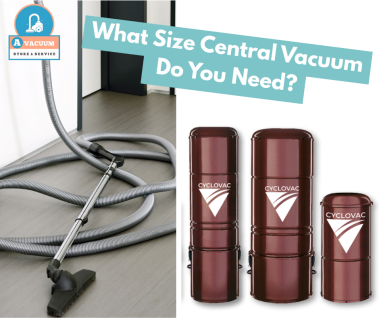
What Size Central Vacuum System Do I Need for My Home?
Choosing the right central vacuum doesn't have to be complicated. The key is matching the system to your home's size, layout, flooring and the way your household actually cleans.
If you've started comparing central vacuum systems, you've probably already seen a lot of numbers.
Square-foot ratings. Air watts. Water lift. Amps. Motor sizes. Coverage recommendations.
It can make choosing a central vacuum feel much more complicated than it really needs to be.
At A Vacuum Store & Service in Calgary, we help homeowners work through these choices all the time.
And most of the time, the right system becomes much easier to identify once we understand the home it's actually going into.
Start With the Size of Your Home
One of the first things we look at is the home's total square footage.
That means all finished levels combined — basement, main floor and upper floors.
A larger home generally has longer piping runs and more area to clean, so it makes sense to choose a system with enough performance and capacity for the job.
A smaller home may perform perfectly with a more compact unit.
You want enough performance to clean comfortably from every inlet without paying for a system that's far beyond what your home actually needs.
Square Footage Isn't the Whole Story
This is where online sizing charts can sometimes oversimplify things.
Two homes can have exactly the same square footage and still have very different central vacuum requirements.
A bungalow with relatively short piping runs isn't the same as a multi-storey home with longer runs, more bends and a very different inlet layout.
The pipe system itself plays an important role in how the vacuum performs.
We want the unit to provide reliable suction whether you're using the inlet closest to the power unit or the one farthest away.
That's why we look at layout and pipe design, not just the number on the floor plan.
The Right Attachments Matter Just as Much
One thing that gets overlooked surprisingly often is the attachment package.
You can have a powerful central vacuum canister and still be disappointed with the cleaning if the wrong floor tools are attached to it.
This matters especially on carpet.
Different carpet constructions can behave very differently with a vacuum nozzle.
Low-pile carpet, Berber, plush carpet and very thick carpet may all benefit from different brush designs or adjustment options.
Sometimes improving the carpet nozzle makes a bigger difference than simply chasing a larger suction number.
A good electric powerhead, the right hard-floor tool and properly matched attachments help the central vacuum actually deliver the performance you're paying for.
Your Lifestyle Matters Too
The way your household uses the vacuum also matters.
A quiet home with mostly hard floors has very different cleaning demands than a busy family home with kids, pets and wall-to-wall carpet.
Homes with heavy shedding, thicker carpet or lots of daily traffic may benefit from a system with stronger overall performance and a well-matched motorized carpet nozzle.
If fine dust and allergens are a concern, filtration and where the system exhausts should also be part of the conversation.
Some central vacuum systems can be vented outdoors, which allows the vacuum's exhaust to discharge outside rather than back into the utility area.
What Do Air Watts and Water Lift Actually Mean?
This is where the specification sheets can start becoming confusing.
Two measurements you'll commonly see are air watts and water lift.
Water lift measures the vacuum's ability to create suction against resistance.
Airflow measures how much air the vacuum can move.
Air watts combine elements of airflow and suction into one performance figure.
All of these numbers can tell us something useful, but none should really be treated as the single answer to whether one central vacuum is better than another.
A strong central vacuum needs a good balance of suction, airflow and overall system design.
Water lift can be particularly useful when comparing suction strength, while airflow is important for carrying dirt and debris through the piping.
The best-performing system is the one where those factors work well together.
What Happens if the Central Vacuum Is Too Small?
An undersized or poorly matched central vacuum can leave you disappointed even if the system technically works.
You may notice weaker performance at longer pipe runs or find that carpet cleaning isn't as effective as expected.
The system may also have to work harder to accomplish the same cleaning job.
But it's important to remember that weak suction isn't always caused by an undersized canister.
A clog, leaking pipe joint, worn hose, blocked filter, poor inlet seal or incorrect attachment can create very similar symptoms.
So before replacing a central vacuum because it "isn't strong enough," it's worth finding out what the actual problem is.
Can a Central Vacuum Be Too Big?
People naturally assume that if some power is good, more must always be better.
Not necessarily.
There's usually no reason to buy far more central vacuum than the home actually requires.
The better approach is to choose a quality system with enough capacity and performance for your home, then pair it with the right hose and cleaning tools.
That's usually a much smarter investment than simply buying the largest unit on the shelf.
Replacing an Existing Central Vacuum Is a Little Different
If your home already has central vacuum piping, choosing a replacement unit is often fairly straightforward — but we still don't recommend choosing purely by square footage.
We want to know how the old system performed.
Was suction strong throughout the house?
Did you like the existing setup?
Were there performance problems?
What kind of carpet and attachments are being used?
Sometimes replacing the canister is all that's needed.
Other times, an older hose, worn powerhead or another part of the system is contributing to the problem.
Why We Don't Rely on a Sizing Chart Alone
Online calculators can be useful as a starting point.
But they don't know how your house is laid out.
They don't know whether you have 80% hard flooring or wall-to-wall plush carpet.
They don't know whether you have three dogs, long piping runs or an attachment package that should have been replaced ten years ago.
Two homes with the same square footage can need very different central vacuum setups.
That's why we would rather ask a few questions first than simply point to a square-foot rating and call it a day.
Building, Replacing or Upgrading? We Can Help
Whether you're building a new home, replacing an older central vacuum or adding a system to an existing house, the goal is the same:
Choose something that fits the home properly and will make cleaning easier for years to come.
At A Vacuum Store & Service, we can help compare central vacuum units, attachment packages and installation options based on your actual home rather than simply recommending the biggest machine available.
We also provide free in-home estimates for new central vacuum installations in Calgary.
And if you already have a central vacuum that isn't performing properly, we can help determine whether the problem is the power unit, hose, piping, powerhead or something much simpler.
Choosing the right central vacuum isn't really about finding the largest motor or the biggest number on a specification sheet.
It's about matching the power unit, piping, hose and attachments to the home they're actually going to clean.
Because the best central vacuum isn't simply the biggest one. It's the one that's properly sized and set up for your home.
No pressure. No sales pitch. Just 25+ years of real vacuum experience in Calgary.
What That Strange Noise From Your Vacuum Is Trying to Tell You
After more than 25 years repairing vacuums, we've learned that a strange new sound is often the machine's way of telling you something has changed.
If your vacuum suddenly starts whistling, rattling, grinding, thumping or making some completely new noise you've never heard before, you're definitely not alone.
Unusual sounds are one of the most common reasons customers bring vacuums into A Vacuum Store & Service.
And that's actually a good thing.
A new sound can sometimes give you an early warning that something needs attention before a small problem turns into a larger one.
High-Pitched Whistling or Screeching
A high-pitched whistle often points to an airflow problem.
The vacuum may be trying to pull air through a restriction somewhere in the system.
That could be a clogged hose, an overfilled bag or bin, a blocked filter or even a restriction in the nozzle.
When airflow is reduced, the sound of the motor and air moving through the machine can change dramatically.
Before assuming the motor is failing, check the simple things first.
Empty the bin or replace the bag, inspect the hose for a blockage and check the filters according to the manufacturer's instructions.
If the noise continues after the obvious airflow problems have been ruled out, that's when it's worth having the vacuum looked at.
Loud Grinding or Rattling
Grinding and rattling are noises we take more seriously because they can point to a mechanical problem.
It may be something relatively simple, such as debris caught in a rotating part.
It can also be caused by worn bearings, a damaged fan, a loose internal component or another part that isn't moving the way it should.
If the sound is harsh, metallic or suddenly much louder than normal, continuing to run the vacuum can sometimes make the problem worse.
This is one of those times when turning the vacuum off is usually the better experiment.
If you can't see an obvious piece of debris causing the noise, bring the vacuum in and let us inspect it before continuing to use it.
Thumping or Banging
A repetitive thumping sound usually makes us think about something that's rotating.
On an upright vacuum or powerhead, the first place to look is often the brush roller.
Hair, string or debris can wrap around it unevenly. A damaged brush roller, worn end cap or object caught in the nozzle can also create a rhythmic knocking sound.
If the noise is coming from the main vacuum body rather than the floor nozzle, the cause may be different and should be investigated before the machine is used much further.
A regular repeating noise usually means something rotating isn't rotating happily.
Hissing or Air-Leak Sounds
A hissing sound often suggests that air is entering or escaping somewhere you wouldn't normally hear it.
A cracked hose is one possibility.
Loose connections, damaged seals, an improperly seated bag compartment or even a partially blocked air path can also change the sound of the vacuum.
You may also notice weaker suction at the same time.
Check the hose, attachments and connections for anything obvious.
If the vacuum suddenly sounds like it's breathing through a crack somewhere, it probably deserves a closer look.
The Brush Roller Suddenly Sounds Much Louder
Sometimes the vacuum itself sounds normal until the carpet brush is turned on.
That's a useful clue.
A noisy powerhead may have hair wrapped around the brush roller, worn bearings, a damaged belt, something caught in the nozzle or wear in the brush motor or drive system.
Pet hair and long human hair are especially good at finding their way into the ends of brush rollers where you can't always see them.
If the noise disappears when the brush is switched off, the problem is likely somewhere in the nozzle rather than the main vacuum motor.
A Sudden Change in Motor Pitch
Sometimes there isn't a dramatic grinding or banging sound.
The vacuum just suddenly sounds different.
Maybe the motor pitch becomes unusually high. Maybe it sounds deeper or strained.
A change in motor sound can be caused by restricted airflow, a blockage, filter problems or wear inside the motor itself.
This is one reason it's useful to pay attention to how your vacuum normally sounds.
You don't need to know exactly what's wrong. You just need to notice that something changed.
What if the Vacuum Suddenly Shuts Off?
If your vacuum suddenly becomes very quiet because it shut itself off, don't immediately keep switching it back on.
Some vacuums have thermal protection that shuts the motor down if it becomes too hot.
A clogged hose, blocked filter, overfilled bag or restricted airflow may contribute to overheating.
Electrical problems or failing components can also cause intermittent operation.
Turn the vacuum off, unplug it and let it cool.
Then check the bag or bin, filters and obvious airflow paths.
If it keeps shutting itself off, don't make restarting it part of your cleaning routine.
That's usually the point where it should be inspected.
Don't Forget About Central Vacuums
Central vacuum systems can give you their own set of strange noises.
A whistle at an inlet, unusual motor noise at the canister, rattling in the power unit or a sudden change in suction can all help point us toward the problem.
The issue could be at the canister, in the hose, at an inlet or somewhere in the piping.
And because the motor is usually installed in a garage, basement or utility area, homeowners sometimes don't hear changes in motor noise as quickly as they would with a portable vacuum.
If your central vacuum suddenly sounds different or isn't performing the way it used to, it's worth having the system checked before assuming the power unit needs replacing.
Why New Noises Are Worth Paying Attention To
Not every strange sound means a major repair.
Sometimes it's a clogged hose.
Sometimes it's a brush roller full of hair.
Sometimes something small has been vacuumed up and is bouncing around somewhere it shouldn't be.
But unusual noises can also be the first sign of worn or failing components.
Catching a problem early can sometimes mean the difference between replacing one worn part and replacing several damaged ones later.
The best time to investigate a strange noise is before it becomes the vacuum's normal noise.
Not Sure What You're Hearing? Bring It In
At A Vacuum Store & Service in Calgary, we offer free in-store estimates for vacuum repairs.
You don't have to diagnose the noise yourself.
Bring the vacuum in, tell us what you've been hearing and we'll take a look at what's actually going on.
Sometimes it's a quick repair or service.
Sometimes a part needs replacing.
And sometimes the strange noise turns out to be much less dramatic than it sounded in your living room.
You know what your vacuum normally sounds like.
So if it suddenly starts whistling, grinding, rattling, thumping or sounding noticeably different, pay attention.
Because when your vacuum starts talking, it's usually worth listening.
No pressure. No sales pitch. Just 25+ years of real vacuum experience in Calgary.
Why Your Vacuum Suddenly Lost Suction (And What to Check First)
After more than 25 years repairing vacuums, we can tell you that sudden suction loss is one of the most common problems we see — and very often, it doesn't mean the vacuum is finished.
You know that feeling.
You're happily vacuuming along, maybe even feeling unusually productive, when suddenly the vacuum is still running but the crumbs, pet hair and mysterious snack remnants are just sitting there staring back at you.
Basically: "Really? That's all you've got?"
Before you start shopping for a replacement, there are a few things worth checking.
Loss of suction is often caused by restricted airflow, not necessarily a failing motor.
First, Think About Airflow
A vacuum depends on air moving freely through the machine.
If that airflow gets restricted somewhere, cleaning performance drops.
A simple way to picture it is a straw.
If the straw is partly blocked, it doesn't matter how hard you try to pull through it — the restriction is still there.
Check the Bag or Dust Bin
This is one of the easiest places to start.
If you use a bagged vacuum, the bag may be fuller than it looks.
Fine dust can pack into the bag material and begin restricting airflow before the bag looks completely stuffed.
If you're using a bagless vacuum, make sure the bin isn't above the manufacturer's fill line.
Sometimes a fresh bag or an emptied bin is enough to make you wonder why you thought the vacuum was dying five minutes ago.
Then Check the Filters
Filters are another very common cause of weak airflow.
Over time they collect fine dust, lint and debris, and once they become clogged, the vacuum has a much harder time moving air through the machine.
Check the filters according to the manufacturer's instructions and clean or replace them when needed.
If the filter is washable, make sure it is completely dry before reinstalling it.
A damp filter and a vacuum motor are not a combination we recommend experimenting with.
Look for a Blockage in the Hose or Wand
If the bag, bin and filters look fine, the next suspect is usually a blockage.
And you would be amazed at what we find inside vacuum hoses.
Socks.
Hairballs.
Pine needles.
Small toys.
Pieces of paper.
And occasionally something that makes everybody ask the same question: "How did that even get in there?"
Disconnect the hose and wand if possible and check for an obstruction.
A flashlight can sometimes help you spot a blockage, especially in shorter sections.
Don't Forget the Brush Roller
Sometimes the vacuum hasn't actually lost suction at all.
It just isn't picking up properly.
A brush roller wrapped in hair and thread can't agitate carpet effectively.
Worn bristles, a stretched or broken belt, or a powerhead that isn't turning properly can create the impression that the vacuum has lost suction even when airflow is still there.
If the hose has good suction but the floor nozzle doesn't, the problem may be underneath the vacuum, not inside the motor.
Check for Air Leaks
A cracked hose or loose connection can also reduce suction.
If air is being pulled in through a split or poorly sealed connection, less suction reaches the cleaning tool.
Inspect the hose, wand connections and any removable seals for obvious damage.
If you hear a hissing noise at the same time as the suction loss, an air leak becomes even more likely.
What About Central Vacuums?
Central vacuum suction problems can be a little different because there are more places for an issue to hide.
The problem could be at the power unit, in the hose, at an inlet or somewhere in the piping.
If suction is weak at every inlet, we start thinking about the canister, filter, bag, motor or a system-wide restriction.
If suction is weak at only one inlet, that can point us in a different direction.
Central vacuum troubleshooting is often about figuring out where the suction changes.
When It's Time to Have the Vacuum Looked At
If you've checked the bag or bin, filters, hose and brush roller and the vacuum still isn't performing properly, that's when it's worth having it inspected.
There may be an internal blockage, worn hose, damaged seal, motor issue, failing fan or another problem that isn't visible from the outside.
At A Vacuum Store & Service in Calgary, we offer free in-store repair estimates.
Bring the vacuum in and we'll take a look at what's actually causing the performance loss before you decide whether repairing or replacing it makes more sense.
In many cases, the vacuum isn't anywhere near the end of its life.
Sometimes it just needs a little attention and a clear path to breathe again.
Before You Replace It, Find Out What's Wrong
Suction loss is frustrating because it can make a perfectly good vacuum suddenly feel useless.
But weak performance doesn't automatically mean the motor is finished or that you need to start shopping for a new machine.
A clogged filter, blocked hose, worn brush roller or simple airflow restriction can completely change the way a vacuum performs.
And those are often much easier problems to solve than replacing the entire vacuum.
So the next time your vacuum is running but the crumbs refuse to cooperate, don't assume the worst.
Check the airflow. Check the bag or bin. Look at the filters, hose and brush roller.
Because sometimes a vacuum that feels like it's lost all its power just needs a blockage cleared and a little TLC.
No pressure. No sales pitch. Just 25+ years of real vacuum experience in Calgary.

Hardwood, Tile, or Carpet? The Right Vacuum for Every Floor Type
After more than 25 years helping people choose vacuums, one thing is very clear: the best vacuum isn't just about the machine. It's about what that machine is being asked to clean.
If you've ever looked at all the different vacuums, attachments, brush rolls and floor settings and wondered why cleaning floors needs to be this complicated, you're definitely not alone.
Most people want the same thing.
Clean floors without wrestling with a machine that sounds like it's preparing for lift-off.
But here's the part that really matters: your flooring changes what you should be looking for in a vacuum.
A vacuum that's fantastic on carpet might be completely unnecessary on hardwood — and the perfect hard-floor vacuum may struggle badly on thick carpet.
Hardwood & Tile: It's All About the Right Floor Tool
Hardwood and tile are a little like that friend who insists they're low-maintenance but somehow notices absolutely everything.
Crumbs.
Dust.
Pet hair tumbleweeds.
One lonely Cheerio sitting in the middle of the kitchen.
For hard flooring, you generally want a vacuum with good airflow and a floor tool designed to pick debris up cleanly without scattering it around.
A canister vacuum with a quality hard-floor brush is an excellent option because the soft bristles help collect fine dust while the open airflow path picks up larger debris.
One example is the SEBO K2 Airbelt Turbo Canister Vacuum .
A central vacuum paired with a soft floor brush can also be a great setup for homes with mostly hardwood or tile. For example, the Cyclovac GS525 Central Vacuum with Low Voltage Kit is designed for homes that don't require an electric carpet powerhead.
And for quick daily pickups, a quality cordless stick vacuum can be extremely convenient. The SEBO Balance A1 Cordless Stick Vacuum is one example.
The biggest thing to avoid is using a floor nozzle that pushes debris around instead of picking it up.
Some rotating brushes can be appropriate on hard floors if they're designed for it or can be switched off. Others may scatter debris or be unnecessarily aggressive on delicate finishes.
If your vacuum is basically snow-plowing Cheerios across the kitchen, the machine may not be the problem.
You may simply need a better floor attachment.
Carpet: Where Brush Agitation Really Matters
Carpet loves to hold onto everything.
Dust. Hair. Crumbs. Sand.
And apparently glitter from the craft project you thought happened three years ago.
The challenge with carpet is that dirt doesn't simply sit on the surface.
It works its way down between the fibres.
That's why a powered brush roller or electric carpet nozzle can make such a big difference.
A good brush roller agitates the carpet, loosens embedded debris and allows the vacuum's airflow to carry that dirt away.
For portable vacuums, an upright or canister with a motorized carpet head is often a strong choice.
Examples include the SEBO E3 Premium Canister Vacuum and the SEBO Felix Premium Upright Vacuum .
A central vacuum can also be excellent for carpet when it's paired with a proper electric power nozzle, such as the Cyclovac 725 Central Vacuum with SEBO ET-1 F2 Kit .
On carpet, you're looking for the right combination of airflow, suction and brush agitation.
Not All Carpet Is the Same Either
This is another part people don't always think about.
Low-pile carpet, Berber, plush carpet and very thick carpet don't necessarily behave the same way under a vacuum.
A powerhead that feels fantastic on standard carpet might seal too tightly to very plush carpet and become difficult to push.
That's why features like height adjustment and airflow control can matter.
The goal isn't simply to find a "carpet vacuum." It's to find one that works properly on your carpet.
Mixed Flooring: Welcome to Most Homes
Most homes don't conveniently choose one flooring type and stick with it.
Maybe there's tile in the kitchen, hardwood through the main floor, carpet upstairs and an area rug exactly where the dog sheds the most.
For mixed flooring, versatility becomes much more important.
One of our favourite setups is a canister vacuum with two dedicated floor tools: a hard-floor brush and an electric carpet powerhead.
You aren't trying to force one attachment to do everything.
You simply use the tool designed for the floor you're cleaning.
A central vacuum can work the same way, with a hard-floor brush for smooth flooring and an electric power nozzle for carpet.
Another setup we see more and more is a full-size vacuum or central vacuum for the real cleaning, with a cordless stick vacuum nearby for quick everyday messes.
Think of the stick vacuum as the quick-response team.
Crumbs after dinner?
Pet hair tumbleweed drifting through the hallway?
Whatever the kids somehow tracked inside five minutes after you finished cleaning?
That's exactly where a cordless vacuum can be incredibly convenient.
Can a Cordless Vacuum Be Your Only Vacuum?
Sometimes.
It depends on the vacuum, the size of your home and your flooring.
For a smaller home with mostly hard floors, a good cordless machine may be all someone needs.
For a larger home with a lot of carpet, pets or heavier cleaning demands, many people prefer having a full-size vacuum or central vacuum available for deeper cleaning.
That's why we don't automatically tell everyone that one vacuum style is "best."
The right answer depends on how much floor you have and what kind of floor it is.
Area Rugs Deserve a Mention Too
Area rugs can complicate things because they're technically sitting on a hard floor but may clean more like carpet.
A lightweight rug may get sucked into an aggressive powerhead.
A thicker rug may need brush agitation to remove embedded dirt.
And delicate rugs may require much gentler cleaning.
Being able to control the brush roller, suction or nozzle height can make transitioning between flooring much easier.
Why Does the Right Vacuum Really Matter?
Using the wrong vacuum for the floor is a little like trying to flip pancakes with a spoon.
Technically, you might get the job done.
But nobody is going to argue that it's the best tool for the job.
The right vacuum should make cleaning easier, pick up debris effectively and work properly with your flooring rather than fighting against it.
It can also help prevent unnecessary wear on the vacuum itself.
A powerhead that constantly struggles against thick carpet, for example, puts more strain on belts, brush motors and other components.
And a floor tool that's wrong for hard flooring can leave you going over the same area again and again.
Nobody wants to vacuum the same Cheerio 78 times.
Not Sure What Works With Your Floors?
One of the easiest ways for us to help someone choose a vacuum is simply to see what they're cleaning.
And yes, customers really do show us photos of their flooring.
It's useful.
A photo can tell us whether we're dealing with plush carpet, low-pile carpet, hardwood, tile, area rugs or some combination of everything.
From there, we can talk about which vacuum styles and attachments actually make sense.
Most people don't need the most expensive vacuum. They need the right vacuum for their floors and the way they live.
Hardwood, tile and carpet all have different cleaning needs.
And in a mixed-flooring home, having the right tools to switch between them can make a bigger difference than simply buying the vacuum with the biggest motor or longest feature list.
If you're not sure what would work best in your home, stop by A Vacuum Store & Service in Calgary, give us a call or bring us a few photos of your floors.
Because the best vacuum isn't just the one that cleans well. It's the one that cleans your floors well.
No pressure. No sales pitch. Just 25+ years of real vacuum experience in Calgary.

Is It Time to Retire Your Old Vacuum? Knowing When to Say Goodbye
After more than 25 years repairing vacuums, one of the most common questions we hear is surprisingly simple: is this one still worth fixing, or is it finally time to replace it?
Every vacuum has its glory days.
The floors look great, the machine moves easily, the suction feels strong and cleaning doesn't turn into a wrestling match.
Then one day, something changes.
Maybe the suction isn't what it used to be.
Maybe it starts making a strange noise.
Maybe there's a burning smell.
Or maybe you're simply spending more time fighting with the vacuum than actually cleaning.
First, Check the Simple Things
Before writing a vacuum off completely, start with the basics.
A full bag, clogged filter, blocked hose or brush roller wrapped in hair can make a perfectly serviceable vacuum feel like it's on its last legs.
Sometimes a new bag, fresh filter or cleared blockage brings the machine right back to life.
Not every weak vacuum is dying. Sometimes it just can't breathe.
When Performance Keeps Getting Worse
If you've checked the obvious things and the vacuum still struggles, that's when we start looking a little deeper.
Worn seals, tired motors, damaged hoses, worn brush rollers and internal restrictions can all reduce cleaning performance.
You may notice that you're going over the same area several times before the floor actually looks clean.
Or the vacuum may sound strained even though nothing obvious is clogged.
Some of these problems are absolutely worth repairing.
Others become harder to justify when several expensive components are worn at the same time.
A Burning Smell Is Not Something to Ignore
If your vacuum suddenly smells hot, burnt or electrical, stop using it until you know what's going on.
Sometimes the cause is fairly simple, like a jammed brush roller or slipping belt.
Other times it may point to overheating, motor trouble or an electrical issue.
A burning smell is not the vacuum's way of saying, "Just one more room."
That's a good time to stop and have it checked.
Parts Availability Can Make the Decision for You
One of the biggest factors in deciding whether a vacuum is worth repairing is something customers don't always think about: can we still get the parts?
Some manufacturers support models for many years.
Others move through product lines quickly, and certain replacement components can become difficult or impossible to source once a model has been discontinued.
This is especially important with machines that rely on proprietary batteries, circuit boards, powered nozzles or molded assemblies that can't simply be substituted with a generic part.
Sometimes the vacuum is repairable in theory, but the part simply doesn't exist anymore.
Repair Cost Matters Too
A vacuum being repairable doesn't automatically mean repairing it is the best choice.
If a relatively inexpensive machine needs a motor, powerhead, hose and several other parts at the same time, the repair bill may not make much sense.
On the other hand, replacing one worn part on a well-built vacuum that still has years of life left can be a very smart repair.
This is why we don't like making the decision based only on the age of the machine.
A ten-year-old vacuum can sometimes be worth fixing. A much newer one sometimes isn't.
Some Vacuums Are Simply Easier to Keep Going
One thing we pay close attention to is serviceability.
Can the motor be replaced?
Can you still get the hose, brush roller, belt, filters and electrical components?
Can the machine be opened, cleaned and repaired without replacing half the vacuum?
Well-supported bagged vacuums and central vacuum systems can often be very serviceable because many wear components are replaceable and parts may remain available for a long time.
But design matters more than simply whether a machine is bagged, bagless, corded or cordless.
There are good and bad examples in every category.
Sometimes the Vacuum Still Works — You Just Don't Like Using It Anymore
Not every replacement decision happens because the vacuum completely dies.
Sometimes your cleaning needs change.
Maybe you've moved into a larger home.
Maybe you now have pets.
Maybe your flooring changed.
Or maybe you're tired of washing filters, constantly emptying a small bin or running out of battery before the house is finished.
If the vacuum technically works but makes cleaning unnecessarily frustrating, it's reasonable to consider something that fits your home better.
A vacuum doesn't have to be completely dead before you're allowed to want something better.
But Don't Replace a Good Vacuum Just Because It's Old
This one is important.
We've seen plenty of older vacuums that still have a lot of life left in them.
Age by itself isn't a diagnosis.
If the machine is well built, parts are still available and the repair cost is reasonable, keeping it going may make far more sense than replacing it.
Sometimes customers come in convinced they need a new vacuum and leave with their old one repaired instead.
And we're perfectly happy when the answer is: "Keep the one you already have."
So When Is It Actually Time to Replace It?
For us, the decision usually comes down to a combination of things.
How much will the repair cost?
What condition is the rest of the vacuum in?
Are parts still available?
Does the machine still suit your home and flooring?
And if we repair this problem, are you likely to get enough additional life out of the vacuum to make that repair worthwhile?
Those questions tell us much more than simply looking at the manufacturing date.
Not Sure Whether to Repair or Replace? Bring It In
At A Vacuum Store & Service in Calgary, we see this situation every day.
Customers bring in an older vacuum and ask us whether it's worth putting money into it.
We'll look at the actual condition of the machine and give you a free in-store repair estimate before you decide.
If the vacuum is worth fixing, we'll tell you.
If we think you're likely to keep putting money into a machine that's at the end of its useful life, we'll tell you that too.
And if replacement makes more sense, we can help you compare options that actually fit your flooring, home and cleaning habits.
Saying goodbye to an old vacuum doesn't have to be based on guesswork.
Sometimes a small repair gives it several more years.
Sometimes the cost, condition and lack of available parts tell a different story.
The goal isn't to keep every vacuum forever or replace one too soon. It's knowing when repairing still makes sense — and when it doesn't.
No pressure. No sales pitch. Just 25+ years of real vacuum experience in Calgary.
It's Time to Check Your Vacuum Filter (Your Air and Floors Will Thank You)
After more than 25 years repairing vacuums, we can tell you that one of the most forgotten parts of vacuum maintenance is also one of the most important: the filter.
When was the last time you checked yours?
If you had to stop and think about it, you're definitely not alone.
Filters tend to be one of those things people forget about until the vacuum starts losing suction, sounding strained or blowing out more dust than it used to.
What Does a Vacuum Filter Actually Do?
A vacuum moves a surprising amount of air.
Along with crumbs, pet hair and visible dirt, that airflow also carries much finer particles.
The filter helps capture those fine particles before air exits the machine.
Depending on the vacuum, there may be one filter, several filters or a combination of a bag and filters working together.
The important thing is that airflow needs to move through the filter, not fight its way through it.
What Happens When the Filter Gets Clogged?
As dust builds up, the filter becomes harder for air to pass through.
That can reduce airflow and make the vacuum feel weaker even though the motor is still running.
You may notice poorer pickup, a change in motor sound or the machine running hotter than usual.
And if the vacuum isn't moving air properly, cleaning performance usually suffers too.
A clogged filter can make a perfectly good vacuum feel a lot older than it really is.
Bagless Vacuums Usually Need More Filter Attention
Bagless vacuums depend heavily on their cyclonic system and filters to separate fine dust from the airflow.
That means filters can collect a significant amount of fine debris over time.
If they're neglected, airflow can drop and the vacuum may start to feel like it doesn't have the power it once did.
Some filters are washable. Others are meant to be replaced.
And some vacuums have both.
This is definitely one of those times when reading the manufacturer's instructions actually helps.
If the Filter Is Washable, Let It Dry Completely
This one is important.
If your vacuum has a washable filter, make sure it is completely dry before putting it back into the machine.
A damp filter can restrict airflow and may cause problems inside the vacuum.
If the filter still feels damp, it's not ready.
Give it more time rather than rushing it back into the machine because you want to finish vacuuming.
Bagged Vacuums Handle Filtration Differently
In a quality bagged vacuum, the bag itself is part of the filtration system.
Modern high-filtration bags can trap a large amount of fine dust before it reaches the vacuum's other filters.
That can make routine maintenance simpler because you're removing a large portion of the collected dirt every time you change the bag.
It also means disposal is generally cleaner because you're not dumping an open dust bin into the garbage.
Bagged vacuums still have filters that need attention, but depending on the design, they may not need cleaning as frequently as filters in some bagless systems.
And What About HEPA Filters?
HEPA filtration can be very useful for capturing fine particles.
But the filter is only one part of the vacuum.
A good filter works best when the vacuum itself is designed so the air actually passes through the filtration system rather than leaking around it.
That's why we look at the whole machine — bags, filters, seals and airflow path — rather than simply looking for a HEPA label.
A great filter is much more useful when the rest of the vacuum is designed to work with it.
Central Vacuums Take Filtration Out of the Living Area
Central vacuum systems work a little differently because the main power unit and dirt container are usually installed in a garage, basement or utility area.
That means you're not carrying the motor and collected debris around the rooms you're cleaning.
Some central vacuum systems can also be vented outdoors, allowing the vacuum's exhaust to discharge outside rather than back into the utility area.
For people who want larger dirt capacity and less day-to-day filter and bin handling, that can be a very convenient setup.
How Often Should You Check Your Vacuum Filter?
There isn't one schedule that applies to every vacuum.
How quickly a filter gets dirty depends on the machine, how often you vacuum and what you're picking up.
Homes with pets, lots of carpet or heavy dust may need filter attention more often.
The safest approach is to follow the manufacturer's recommended cleaning and replacement schedule — and check the filter sooner if performance starts changing.
If you can't remember the last time you looked at it, today is probably a pretty good day.
Don't Keep Washing a Filter Forever
Washable doesn't necessarily mean permanent.
Filters can eventually become worn, damaged or permanently loaded with fine debris.
If the filter looks damaged, no longer comes clean or the vacuum still has poor airflow after maintenance, replacement may be the better option.
And if you're not sure which filter your vacuum uses, bring the model information into the store and we can help you identify the correct one.
Still Losing Suction After Cleaning the Filter?
Then the filter may not be the problem.
A blocked hose, overfilled bag, cracked hose, worn brush roller or another airflow restriction can create many of the same symptoms.
At A Vacuum Store & Service in Calgary, we offer free in-store repair estimates if your vacuum isn't performing the way it should.
Sometimes all it needs is a filter.
Sometimes there's something else going on.
Either way, it's usually better to find out what's actually wrong before assuming you need a new vacuum.
Vacuum filters aren't exciting.
Nobody buys a vacuum because they're thrilled about cleaning a filter.
But keeping the filtration system maintained can help preserve airflow, cleaning performance and the overall health of the machine.
So here's your reminder: go check your vacuum filter.
No pressure. No sales pitch. Just 25+ years of real vacuum experience in Calgary.
Why Your Vacuum Loses Suction and How We Fix It
After more than 25 years repairing vacuums, loss of suction is still one of the most common problems we see — and very often, the vacuum itself isn't anywhere near finished.
There aren't many things more frustrating than pulling out your vacuum, turning it on and realizing it's barely picking anything up.
The motor is running.
The brush might even be spinning.
But somehow the crumbs are winning.
The good news is that weak suction often comes down to an airflow problem, and many of those problems can be repaired without replacing the entire vacuum.
The Hose Is Often the First Suspect
Vacuum hoses collect far more than dust.
Over the years we've found hair ties, paper clips, coins, socks, dog treats, scrunchies and all kinds of other things that somehow made their way into a hose.
Sometimes the blockage is obvious.
Other times, a relatively small object catches a little hair and debris, then slowly builds itself into a surprisingly effective plug.
If the hose can be removed, you can check for an obvious blockage by looking through it or shining a light through where possible.
If you have another working vacuum, it may sometimes be possible to use its suction from the opposite end to help pull a loose blockage back out.
One thing we don't recommend: forcing a wire coat hanger down an electric vacuum hose.
Electric hoses can have wiring running through them, and an aggressive piece of wire can turn a simple clog into a much more expensive hose repair.
If the blockage is deep or difficult to reach, we have tools and compressed air in the shop that can help clear it without blindly poking around inside the hose.
Dirty Filters Can Make a Good Vacuum Feel Weak
Filters are designed to trap fine dust before it travels where it shouldn't.
But eventually all that trapped dust can begin restricting airflow.
That's when people often tell us: "It just doesn't suck like it used to."
Some vacuum filters are washable.
Some are disposable.
And even washable filters don't necessarily last forever.
Check the manufacturer's instructions before cleaning one, and if it is washable, make sure it's completely dry before putting it back into the vacuum.
At the store, we carry replacement filters and vacuum bags for many brands and models, and we can help identify the correct one if you're not sure what your machine takes.
Sometimes It's the Bag or Dust Bin
A full bag can reduce airflow long before the vacuum completely stops picking up.
Fine dust can also load the bag material and make it harder for air to pass through.
With bagless vacuums, make sure the dust bin is seated properly and isn't filled above the manufacturer's recommended line.
If the bin, lid or seals aren't sitting correctly, the vacuum may pull air through the wrong place instead of through the floor tool.
Sometimes the suction problem isn't that the vacuum can't make suction. It's that the suction isn't reaching the floor.
Cracked Hoses and Air Leaks
A vacuum can have a perfectly functioning motor and still feel weak if air is leaking out — or being pulled in — somewhere along the hose or connection.
Small cracks, damaged cuffs, loose fittings or worn seals can all reduce the amount of suction that actually reaches the cleaning tool.
Sometimes you can hear the leak as a faint hiss.
Other times, the only clue is poor pickup.
We can test the hose and connections, determine where the leak is coming from and see whether the damaged part can be repaired or whether replacement makes more sense.
Don't Forget the Brush Roller
Sometimes what looks like suction loss isn't suction loss at all.
If the hose has good airflow but the vacuum isn't picking dirt out of the carpet, the problem may be in the brush roller or powerhead.
Hair and thread can wrap tightly around the roller.
Belts can stretch or break.
Brush bristles wear down.
A powerhead can also develop mechanical or electrical problems that prevent the brush from doing its job.
Good carpet cleaning needs more than airflow. The brush has to actually lift the dirt too.
What if Everything Looks Fine but Suction Is Still Weak?
That's when we start looking inside the machine.
There may be an internal restriction, a damaged seal, a worn motor, a dirty fan or another problem that isn't visible from the outside.
Bagless vacuums in particular can accumulate very fine dust inside areas that aren't part of normal homeowner maintenance.
Depending on the design, we may be able to disassemble the vacuum, clean internal pathways, inspect the motor and carbon brushes where applicable, and test the machine to determine what's actually causing the performance problem.
The important part is figuring that out before spending money unnecessarily.
Central Vacuums Can Lose Suction Too
With a central vacuum, weak suction can come from the hose, power unit, filter, bag, inlet or somewhere inside the piping system.
One of the first things we want to know is whether the problem happens at every inlet or only one.
That simple detail can help narrow down where the problem is.
Sometimes the unit itself needs service.
Sometimes there's a clog in the piping.
And sometimes the problem turns out to be the hose or powerhead rather than the central vacuum canister at all.
Before replacing a central vacuum because it feels weak, find out which part of the system is actually causing the problem.
How We Diagnose Suction Problems
When a vacuum comes into the shop with poor suction, we don't automatically assume it needs a motor.
We work through the system.
Airflow.
Filters.
Hoses and seals.
Brush roller and powerhead.
Internal pathways.
Motor condition if necessary.
That helps us separate a simple maintenance problem from an actual mechanical failure.
At A Vacuum Store & Service in Calgary, we offer free in-store repair estimates, so you'll know what the problem is and what the repair would involve before deciding what makes sense.
Don't Toss It Before You Know What's Wrong
A vacuum that isn't picking up properly can feel completely useless.
But we've seen plenty of machines come into the shop that customers thought were finished when the actual problem was a clog, filter, belt, hose or another repairable issue.
Vacuums do a lot of dirty work.
Every once in a while, they need some cleaning and maintenance too.
Before replacing it, give the old vacuum a chance to explain itself.
Bring It In Anytime
If your vacuum isn't cleaning the way it used to, bring it into A Vacuum Store & Service and we'll take a look.
No appointment is necessary, and we're open seven days a week.
We service and repair canister vacuums, upright vacuums, cordless vacuums, central vacuum systems, carpet cleaners and more.
If the machine is worth repairing, we'll tell you.
And if it isn't, you'll at least know what's actually wrong before replacing it.
Weak suction doesn't automatically mean a weak motor.
A blocked hose, dirty filter, worn brush roller, leaking connection or other airflow problem can completely change the way a vacuum performs.
So before you give up on the machine, find out where the suction went.
No pressure. No sales pitch. Just 25+ years of real vacuum experience in Calgary.


Why We Recommend Cyclovac Central Vacuum Systems
A central vacuum should make cleaning easier, not more complicated. That's one of the reasons Cyclovac systems have become such an important part of what we offer at A Vacuum Store & Service.
Cyclovac central vacuums are manufactured in Canada and offer a wide range of power units designed for different home sizes, layouts and cleaning needs.
And that's important, because there really isn't one central vacuum that makes sense for every house.
A smaller bungalow with mostly hard flooring doesn't necessarily need the same system as a large multi-level home with pets, carpet and long piping runs.
The goal isn't simply to buy the biggest central vacuum. It's to install the right system for the home.
Why We Like Cyclovac
One of the things we appreciate about Cyclovac is the range of options.
There are systems suited to smaller homes, larger homes and installations where stronger performance or greater capacity is needed.
There are also bagged and hybrid options, depending on how you prefer to maintain and empty the system.
That allows us to recommend a central vacuum based on the house and the customer rather than trying to make one model fit every situation.
Retraflex Makes the Hose Almost Disappear
One of our favourite central vacuum upgrades is the Retraflex retractable hose system.
Traditional central vacuum hoses work very well, but storing a 30-, 40- or even longer hose isn't everyone's favourite part of owning one.
Retraflex solves that problem by storing the hose inside the vacuum piping.
When you want to vacuum, you pull out the amount of hose you need.
When you're finished, the vacuum's suction helps retract the hose back into the wall.
No coiling a giant hose. No trying to convince it to behave in a closet.
For new construction and renovations especially, Retraflex can be a very convenient way to build central vacuuming directly into the home.
The Attachments Matter Just as Much as the Canister
Something we talk about a lot with central vacuums is the attachment package.
The power unit may be mounted in the garage or basement, but the part actually touching your floor is the hose and cleaning tool.
For homes with mostly hardwood or tile, a quality hard-floor brush may be all that's needed.
For homes with carpet, especially thicker carpet or homes with pets, an electric powerhead can make a major difference.
A powerful central vacuum with the wrong carpet nozzle can still disappoint. The right attachments complete the system.
Central Vacuums Keep the Main Unit Out of the Living Space
Another advantage of a central vacuum is that the motor and dirt container are usually located away from the rooms you're cleaning.
That means you're not carrying the motor, dust bin or bag from room to room.
Many central vacuum systems also offer larger dirt capacity than a typical portable vacuum, so they generally need to be emptied less often.
And when a central vacuum is vented outdoors, the vacuum's exhaust is discharged outside rather than back into the utility area.
For homeowners who care about containing fine dust and keeping the vacuum's motor and collected debris away from the main living areas, that's one of the reasons central vacuum systems remain so appealing.
They're Not Just for New Homes
A lot of people assume central vacuum systems are something you can only install while a house is being built.
That's not necessarily the case.
New construction is certainly the easiest time to plan the piping and inlet locations, but central vacuums can often be added to existing homes too.
The installation depends on the home's layout, basement access, wall construction and where the piping can be routed.
That's exactly why we prefer looking at the house rather than trying to quote every installation from a floor plan or over the phone.
Building a New Home? Plan the Central Vacuum Early
If you're building or doing a major renovation, planning the central vacuum before the walls are finished can make installation much easier.
We can plan inlet locations, piping routes, VacPans, the power-unit location and Retraflex retractable hose systems before drywall closes everything in.
Then once the home is finished, we return to complete the inlets, install the power unit and set up the attachments.
The earlier we can look at the layout, the more options we usually have.
Already Have Central Vacuum Piping?
If your home already has a central vacuum system, you don't necessarily need to replace everything when the old canister reaches the end of its life.
In many cases, the existing piping and inlets can continue to be used with a new Cyclovac power unit.
We can also look at the hose, powerhead and existing attachments to see whether those should be kept, repaired or upgraded.
Sometimes replacing the canister is all that's needed.
Sometimes updating the attachments makes just as much difference.
Free In-Home Central Vacuum Estimates in Calgary
Every house is different, which is why we offer free in-home estimates for new central vacuum installations in Calgary.
We can look at the size and layout of the home, determine practical inlet locations, discuss the power unit and attachment options, and figure out whether a traditional hose or Retraflex system makes more sense.
We install central vacuum systems in new construction and existing homes, and we can also help with replacement power units, upgrades and central vacuum repairs.
The idea is simple: design the system around the home rather than trying to make the home fit the system.
A well-designed central vacuum can be one of those features you don't think much about once it's installed.
You plug in — or pull out the Retraflex hose — clean the house and put everything away.
That's exactly how it should be.
Because a good central vacuum system shouldn't make cleaning more complicated. It should make cleaning easier.
No pressure. No sales pitch. Just 25+ years of real vacuum experience in Calgary.
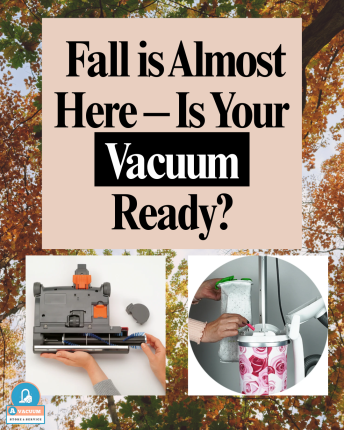
Get Ready for Fall Cleaning: Keep Your Home and Vacuum Happy
Fall has a way of bringing a little more of the outdoors inside. Leaves, dirt, damp shoes and pet hair all seem to find their way onto the floor — which makes this a very good time to make sure your vacuum is ready too.
Summer starts winding down, the sweaters come back out, and suddenly the front entrance seems to collect half the neighbourhood.
Leaves.
Mud.
Dust.
And if you have pets, somehow even more hair than usual.
A little vacuum maintenance now can save you from discovering a problem right when the fall mess really starts.
Start With a Quick Vacuum Check
You don't need to take the whole vacuum apart.
A few basic checks can tell you a lot.
Take a look at the brush roller and remove any hair, thread or string wrapped around it.
Check the hose for obvious cracks or blockages.
If your vacuum uses a bag, make sure it isn't overdue for replacement.
If it's bagless, empty the bin and make sure it is properly seated.
And don't forget the filters.
Check the Filters Before the Busy Season
A clogged filter can reduce airflow and make a perfectly good vacuum feel weak.
If the filter is washable, follow the manufacturer's instructions and make sure it is completely dry before reinstalling it.
If it's a replacement-style filter, fall is a good time to check whether it's due.
If you can't remember the last time you looked at the filter, that's probably your answer.
Take a Look at the Brush Roller and Belts
Fall dirt can be tough on carpets, especially when sand, grit and pet hair start getting worked into the fibres.
That's where the brush roller becomes important.
If it's packed with hair or the bristles are badly worn, carpet pickup can suffer.
On belt-driven machines, a stretched or worn belt can also keep the brush from turning the way it should.
Good carpet cleaning needs the brush to do its share of the work — not just the motor.
Make the Front Entrance Work Harder
One of the easiest ways to reduce fall dirt is to stop some of it before it spreads through the house.
A good entrance mat can catch a surprising amount of grit, moisture and debris before it reaches carpet or hardwood.
And high-traffic areas are worth vacuuming a little more often during fall.
The longer sand and grit sit in carpet, the more they get walked down between the fibres.
Five minutes at the entrance can sometimes save twenty minutes everywhere else.
If You Have Carpet, Make Sure the Powerhead Is Ready
For homes with carpet, a motorized power nozzle can make a big difference when you're dealing with embedded dirt and pet hair.
But it only helps if it's working properly.
Listen for unusual noises, check that the brush roll is actually spinning, and make sure hair hasn't wrapped tightly around the ends.
If the hose has plenty of suction but the carpet isn't getting clean, the powerhead may be where the problem is.
Central Vacuum or Portable? Either Can Work Well
Central vacuums can be especially convenient during heavier cleaning seasons because they usually have larger dirt capacity and keep the main motor and collection container away from the rooms you're cleaning.
When a central vacuum is vented outdoors, the exhaust is discharged outside rather than into the utility area.
For carpeted homes, pairing the system with a good electric power nozzle can make it a very capable whole-house setup.
But if central vacuum isn't practical for your home, a good full-size portable vacuum can do an excellent job too.
We carry SEBO and other portable options, and the best choice really comes down to your flooring, home size, pets, stairs and how you like to clean.
The best fall-cleaning vacuum isn't necessarily a central or portable. It's the one that makes sense for your house.
Don't Forget the Quick-Cleanup Vacuum
A cordless stick vacuum can also be incredibly handy during fall.
Not necessarily because it replaces your main vacuum, but because it's easy to grab when somebody tracks dirt through the entrance or the dog brings half the backyard inside.
That combination — a full-size or central vacuum for deeper cleaning and a cordless vacuum for quick pickups — works very well in a lot of homes.
Because nobody wants to pull out the full cleaning setup for four leaves and one Cheerio.
When Your Vacuum Needs More Than a Quick Check
If your vacuum has weak suction, a noisy brush roller, a burning smell, a damaged hose or just isn't cleaning the way it used to, fall is a good time to have it looked at.
At A Vacuum Store & Service in Calgary, we offer free in-store repair estimates.
No appointment is necessary.
Sometimes the machine only needs a filter, bag, belt or cleaning.
Sometimes there's a repair that needs attention.
Either way, it's much nicer to find out before you're halfway through the first big fall cleaning.
Thinking About a Central Vacuum Upgrade?
Fall can also be a good time to replace an older central vacuum canister or upgrade the hose and attachment package.
If you're considering a new system, we can help you choose a Cyclovac setup based on your home's size, flooring and cleaning needs.
You can also take a look at our current Cyclovac Central Vacuum Fall Promotion .
And for new installations, we offer free in-home central vacuum estimates in Calgary.
Everything You Need for Fall Vacuum Maintenance
We carry vacuum bags, filters, belts, brush rollers, hoses, attachments, cleaning products and replacement parts for many vacuum brands and models.
If you aren't sure what your vacuum needs, bring in the model information — or the vacuum itself — and we'll help you figure it out.
Sometimes the smallest maintenance item makes the biggest difference.
Fall cleaning doesn't need to be complicated.
Check the filters, clear the brush roller, make sure the bag or bin is ready and give the hose a quick inspection.
Then let the vacuum do what it's supposed to do.
A little maintenance before fall can mean a lot less frustration once the leaves start coming inside.
No pressure. No sales pitch. Just 25+ years of real vacuum experience in Calgary.
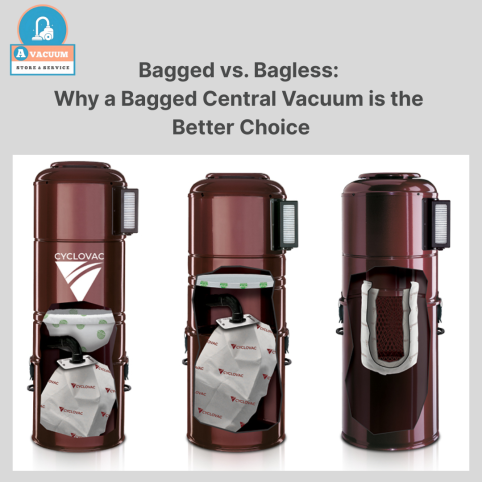
Bagged vs. Bagless Central Vacuums: Which Is Easier to Live With?
One of the most common central vacuum questions we hear is simple: should I choose a bagged system or a bagless one?
Both designs can work well.
But for a lot of homeowners, bagged central vacuums are simply easier to maintain, cleaner to empty and more convenient to live with day to day.
Bagless sounds simpler at first. In practice, some people find the bag is actually the easier option.
The Biggest Difference Is How You Empty It
With a bagged central vacuum, the collected dirt stays inside the bag until it's time to change it.
You remove the old bag, dispose of it and install a new one.
That's usually a pretty clean process because you're not dumping a container full of fine dust into the garbage.
With a bagless system, you empty the dirt canister directly.
That isn't necessarily difficult, but fine dust can become airborne during emptying — especially if the bin is very full or the debris is light and powdery.
The Bag Is Part of the Filtration System
In a bagged central vacuum, the bag doesn't just hold dirt.
It also plays a role in filtration.
A good-quality central vacuum bag can capture a large amount of fine debris before the air reaches the system's other filters.
That can reduce how much dust collects elsewhere inside the machine.
Bagless systems handle debris differently and may rely more heavily on cyclonic separation, screens or filters depending on the design.
Neither design is magic. They just manage dirt in different ways.
Bagged Systems Can Mean Less Hands-On Maintenance
This is probably the biggest reason we tend to like bagged central vacuums.
For many homeowners, maintenance is very simple: use the vacuum, check the bag occasionally and replace it when needed.
Bagless systems can require more direct cleaning of the dirt container, filter, screen or separator depending on the model.
That isn't necessarily a problem if you don't mind doing it.
But if your ideal vacuum-maintenance routine is "the less I have to touch the dirt, the better," a bagged system makes a lot of sense.
What About Suction as the Bag Fills?
A common concern is whether a vacuum bag causes suction to drop as it fills.
Any vacuum can lose airflow when its dirt collection system becomes overly full or restricted.
Modern central vacuum bags are designed to allow airflow through the bag material while trapping debris.
As long as the bag is changed before it's excessively full, performance can remain very consistent.
Bagless systems can also maintain good airflow when properly maintained, but filters and screens need to stay clean.
The real enemy isn't the bag or the bin. It's restricted airflow.
Central Vacuum Bags Are Much Bigger Than Portable Vacuum Bags
People sometimes hear "bagged vacuum" and imagine changing a small bag every couple of weeks.
Central vacuum bags are usually much larger.
Depending on the size of the system, how often you vacuum, the size of your home and whether you have pets, a bag may last for months.
Some homes may only need a couple of bag changes a year.
Others will need them more often.
The nice part is that changing the bag is usually a very occasional chore.
Does Bagged Mean Better for Allergies?
For people who prefer to minimize direct contact with collected dust, a bagged system can be more comfortable to empty because the debris stays contained inside the bag.
But the overall filtration performance of a central vacuum depends on more than whether it uses a bag.
The filter design, seals, airflow path and whether the central vacuum is vented outdoors can all matter too.
If the system is vented outside, the vacuum's exhaust is discharged outdoors rather than into the utility area.
So if filtration is important to you, look at the whole system — not just the word "bagged."
Are Bagless Central Vacuums Bad?
No.
There are plenty of people who prefer bagless central vacuums because they don't have to keep replacement bags on hand.
Some also like being able to see how much dirt is in the canister.
If the system is designed well and maintained properly, a bagless central vacuum can work very well.
Our preference for bagged systems is mostly about convenience, cleaner disposal and simpler routine maintenance.
It's not that bagless can't work. We just find that many homeowners prefer living with the bag.
What About Hybrid Central Vacuums?
Some central vacuum systems are hybrid, which means they can be used either with a disposable bag or without one.
That can be a nice option if you want flexibility.
You can use the bag for cleaner disposal and easier maintenance, while still having the option to operate the unit differently if needed.
Several Cyclovac systems are available in hybrid configurations, which is one of the reasons we like having different options rather than forcing every customer into the same setup.
Bagged Central Vacuum FAQ
Do I need a specific bag for my central vacuum?
Yes. Bags need to match the machine's intake connection, size and design. If you're unsure which one you need, the model number of the power unit usually helps us identify the correct bag.
How often should I change the bag?
There isn't one schedule for every home. Many full-size central vacuum bags last several months, but homes with pets, more occupants or heavier cleaning may fill them faster. It's better to check the bag periodically than wait for a noticeable drop in airflow.
Are central vacuum bags expensive?
They are generally a relatively small maintenance cost, especially because central vacuum bags can hold a large amount of debris and may only need to be changed occasionally.
What happens if I leave the bag too long?
If a bag becomes excessively full or loaded with fine dust, airflow can begin to drop. Changing it before it reaches that point helps the system perform properly.
Can I switch a bagless central vacuum to bags?
That depends entirely on the model. Some systems are designed as hybrids and can use either method. Others are strictly bagged or bagless. Check the manufacturer's design before trying to convert anything.
Which One Would We Choose?
If someone tells us they want the simplest possible maintenance and don't want to deal with dusty bins, we're usually going to point them toward a bagged or hybrid central vacuum.
It's straightforward.
Use the system.
Check the bag occasionally.
Replace it when necessary.
Done.
But if someone strongly prefers bagless and doesn't mind the extra hands-on maintenance, we'll talk through those options too.
Bagged and bagless central vacuums can both clean a home effectively.
The difference is often less about cleaning power and more about how you want to maintain the system afterward.
For a lot of homeowners, the biggest advantage of a bagged central vacuum is simple: less mess, less handling and one less cleaning chore to think about.
No pressure. No sales pitch. Just 25+ years of real vacuum experience in Calgary.
Vacuum Carpet Attachments: Why the Right Floor Tool Matters
After more than 25 years selling and repairing vacuums, one thing we wish more people knew is that the vacuum itself is only part of the equation. When you're cleaning carpet, the attachment touching the floor can make a huge difference.
You know those satisfying little lines your vacuum leaves behind on the carpet?
They look great.
But carpet lines don't necessarily tell you how much dirt was actually removed.
A vacuum can groom the surface beautifully while still struggling with hair, sand and debris deeper in the carpet.
Why Carpet Needs Agitation
Hard floors and carpet behave very differently.
On a hard floor, debris is sitting on a relatively flat surface where airflow and a good floor brush can pick it up.
Carpet gives dirt somewhere to hide.
Hair, grit and debris can work their way between and around the carpet fibres instead of sitting neatly on top.
That's why a rotating brush roll can be so important. The brush agitates the carpet and helps loosen debris so the vacuum's airflow can carry it away.
Good carpet cleaning is a partnership: agitation loosens the dirt, and airflow carries it away.
What Makes an Electric Powerhead Different?
A full-size electric powerhead has its own motor driving the brush roller.
That means the brush doesn't depend on the vacuum's airflow to make it spin.
For homes with a significant amount of carpet, especially when there's pet hair or heavier cleaning involved, this can provide more consistent brush agitation.
It's one of the reasons we often recommend an electric powerhead when someone tells us carpet cleaning is a priority.
A powerful vacuum paired with a poor carpet attachment can still give disappointing results.
What About Air-Driven Turbo Brushes?
Air-driven turbo brushes use the vacuum's airflow to spin a turbine, which then turns the brush roller.
They can work very well in the right situation.
For area rugs, lower-pile carpet or homes with mostly hard flooring and a smaller amount of carpet, a good turbo brush may be all someone needs.
Where they can struggle is on certain thicker or denser carpets.
As resistance increases, an air-driven brush may slow down because the same airflow being used for suction is also what powers the brush.
That's very different from saying turbo brushes are bad.
They're simply a different tool — and every tool has a job it's better suited for.
And Then There Are Combination Floor Tools
Combination tools are popular because one attachment can move between hard flooring and some types of carpet.
They're convenient, compact and perfectly useful in the right home.
But convenience and deep carpet cleaning aren't always the same thing.
If you have wall-to-wall carpet, pets or carpet that holds onto hair and grit, a dedicated rotating carpet brush will usually give you more agitation than a simple combination nozzle.
One attachment that does everything sounds wonderful. Sometimes two tools simply do their individual jobs better.
Pet Hair Really Shows the Difference
If you've ever tried removing pet hair from carpet with suction alone, you already know why brush agitation matters.
Hair can cling to carpet fibres instead of lifting easily into the airflow.
A rotating brush helps loosen and lift that hair so the vacuum has a better chance of carrying it away.
That doesn't mean every motorized powerhead is automatically excellent for pet hair.
Brush design, bristle condition, airflow and maintenance all matter too.
And no matter what the box promises, we still haven't met a brush roller that appreciates being wrapped in six months of hair.
Carpet Height Adjustment Matters More Than People Realize
Another feature we pay attention to is height adjustment.
Carpets aren't all the same.
Low pile, medium pile, plush and other carpet constructions can interact very differently with a vacuum nozzle.
If a powerhead is set too low for the carpet, it may become difficult to push, restrict airflow or prevent the brush from operating properly.
Too high, and the brush may not make enough contact with the carpet to agitate it effectively.
The goal is proper brush contact without making the powerhead feel like it's glued to the floor.
Harder to push doesn't mean deeper cleaning. Sometimes it means the setting is wrong.
Some Carpets Need Special Consideration
This is also why we don't like giving one blanket recommendation for every carpet.
Very plush, high-pile or specialty carpet may have specific vacuum requirements from the flooring manufacturer.
Certain carpet constructions may need a particular type of brush, height setting or nozzle design to clean properly without making the vacuum excessively difficult to move.
If you've invested in new carpet, it's worth checking the carpet manufacturer's care recommendations before choosing a vacuum or powerhead.
Don't choose the carpet tool based only on the vacuum. Choose it based on the carpet too.
The Brush Roller Doesn't Stay New Forever
Here's something else people don't always realize: brush rollers wear out.
After years of running across carpet, the bristles can become shorter, softer or worn unevenly.
The powerhead may still sound completely normal and leave beautiful carpet lines, but the brush may no longer be agitating the carpet the way it did when it was new.
Belts, bearings and other powerhead components can wear too.
That's why sometimes improving carpet performance doesn't require replacing the entire vacuum.
Sometimes the vacuum is fine. The attachment doing the actual cleaning needs attention.
Central Vacuums Need the Right Carpet Tool Too
This is especially important with central vacuum systems.
People sometimes focus entirely on how powerful the central vacuum canister is.
But if the home has a lot of carpet, the powerhead is a major part of how well the overall system cleans.
A properly matched electric powerhead can make a noticeable difference compared with using an attachment that isn't suited to the carpet.
So when we're putting together a central vacuum package, we don't just look at the power unit.
We look at what will actually be cleaning the floors.
Do You Really Need a Full-Size Electric Powerhead?
Not necessarily.
If your home is almost entirely hardwood with one small low-pile rug, buying a large electric carpet powerhead may be unnecessary.
But if you have wall-to-wall carpet, pets, heavier traffic or carpet that tends to hold onto hair and grit, a full-size motorized powerhead can be well worth having.
That's why the answer depends on the home rather than simply choosing whichever attachment looks most impressive.
Not Happy With How Your Vacuum Cleans Carpet?
Don't automatically assume you need a new vacuum.
Bring the machine or powerhead into A Vacuum Store & Service in Calgary and we can take a look at what you're currently using.
Sometimes the problem is a worn brush roller or belt.
Sometimes the attachment isn't a good match for the carpet.
And sometimes a different vacuum really would make more sense.
We'll help you figure out which situation you're dealing with before you spend money replacing something unnecessarily.
Those neat little carpet lines are satisfying.
We're not taking that away from anyone.
Just remember that good carpet cleaning comes from the whole system working together: airflow, suction, brush agitation, proper height and the right attachment for the carpet.
Because when it comes to carpet, the lines are nice — but getting the dirt out is the part that actually matters.
No pressure. No sales pitch. Just 25+ years of real vacuum experience in Calgary.

Can a Robot Vacuum Really Clean Carpet?
Robot vacuums are convenient, clever and genuinely useful. But if you have carpet, the real question is whether they can actually clean it well enough to replace a regular vacuum.
Robot vacuums are pretty impressive.
You schedule them, they wander around the house picking up crumbs and pet hair, and somehow the floors look better while you're doing something completely unrelated.
What's not to like?
But carpet changes the conversation a little.
The Short Answer: Yes... But With Limits
Robot vacuums can clean carpet.
They're useful for picking up surface dust, crumbs, pet hair and everyday debris, especially when they run frequently.
For maintenance cleaning, that can make a noticeable difference.
Where they generally don't perform the same way as a good upright, canister or central vacuum is deeper carpet cleaning.
Think of a robot vacuum as a very enthusiastic maintenance cleaner.
Why Carpet Is Harder to Clean
On hard flooring, debris is sitting on the surface where the vacuum can reach it fairly easily.
Carpet gives dirt somewhere to hide.
Sand, grit, hair and fine debris can work their way between the fibres.
To remove that effectively, you usually want a combination of airflow and strong brush agitation.
Robot vacuums do have brush rollers, and many newer models increase suction automatically when they detect carpet.
But their compact size limits how large the motor, airflow path and brush system can be compared with a full-size vacuum.
Small is convenient. Small also means there are some physical limits.
Low-Pile Carpet Is Usually Easier
Not all carpet gives a robot vacuum the same challenge.
Low-pile and flatter carpet is generally easier for a robot to move across and clean.
Thicker, softer or higher-pile carpet can be more difficult.
The robot may have more resistance, the brush may not reach as effectively, and some models can struggle with transitions or deep pile.
This is one reason reviews can be misleading.
A robot that works beautifully in somebody else's home may behave very differently on your carpet.
Pet Hair Is Where Robots Can Be Really Handy
If you have a shedding pet, running a robot vacuum regularly can help stop hair from building up as quickly.
That can be genuinely useful.
Instead of waiting until there's enough hair on the floor to build another dog, the robot picks up a little every day.
But carpeted pet homes may still benefit from periodic cleaning with a stronger motorized powerhead that can agitate the carpet more aggressively.
The robot helps keep up with the hair. The full-size vacuum handles the deeper clean.
What Robot Vacuums Are Actually Very Good At
Where robots really shine is consistency.
Most people don't feel like vacuuming every day.
A robot doesn't care.
It will happily make its rounds over and over again, picking up small amounts of dirt before they build into a bigger mess.
That makes them great for everyday maintenance, especially in busy homes with pets, kids or lots of hard flooring.
They're excellent at doing the cleaning you probably weren't going to do that day anyway.
Where They Still Can't Replace a Regular Vacuum
A robot only cleans where it can physically travel.
It isn't cleaning your stairs.
It isn't vacuuming the sofa.
It isn't getting cobwebs from the ceiling corners or cleaning the car.
And although mapping and edge cleaning have improved a lot, there are still areas around furniture, tight corners and obstacles that may need attention from a regular vacuum.
That's why we usually think of robot vacuums as part of the cleaning routine rather than the entire cleaning routine.
The Maintenance People Forget About
Robot vacuums are automatic.
They are not maintenance-free.
Hair still wraps around brush rollers.
Side brushes wear.
Wheels collect hair and debris.
Filters get dirty.
Sensors need cleaning.
And batteries eventually lose capacity.
The robot may clean the floor by itself. Unfortunately, it still hasn't learned to clean itself.
What About Self-Emptying Models?
Self-emptying bases can definitely make robot vacuums more convenient.
Instead of emptying the small onboard bin after every few runs, the robot transfers the dirt into a larger container or bag at the charging station.
That's useful, especially in homes with pets.
But the system still needs maintenance.
The base eventually needs to be emptied, filters need attention, and the brushes and sensors still need cleaning.
Self-emptying means less frequent handling.
It doesn't mean "never think about the vacuum again."
Repairs and Parts Are Worth Thinking About Too
Robot vacuums pack a surprising amount of technology into a very small machine.
That means there are wheels, sensors, circuit boards, brush motors, pumps on some models, batteries and other components that can eventually wear or fail.
And unlike many traditional vacuums, replacement parts for certain robot models aren't always readily available.
That doesn't mean robots aren't worth owning.
It just means repairability is something worth considering before buying an expensive one.
So Should You Buy a Robot Vacuum?
If you're buying one because you never want to touch another vacuum again, you may be disappointed.
But if you're buying one to keep everyday dust, crumbs and pet hair under control between deeper cleanings, they can be extremely useful.
For many homes, the best setup isn't robot or regular vacuum.
It's both.
Let the robot handle the repetitive everyday cleanup, and use your upright, canister or central vacuum when the carpet needs more attention.
Already Have One That Isn't Working Properly?
We do see robot vacuums come into the shop with brush problems, charging issues, wheel problems, error codes and other faults.
At A Vacuum Store & Service in Calgary, we're happy to take a look and see what's going on.
Parts for robot vacuums aren't always manufactured or available, so not every repair is possible.
But when parts are available and the repair makes sense, we'll always do our best to help.
Robot vacuums have earned their place in a lot of homes.
They're convenient, consistent and very good at keeping everyday mess from getting out of control.
Just don't expect a little machine quietly wandering around under the couch to do every cleaning job in the house.
For carpet especially, think of the robot as the sidekick — not necessarily the superhero.
No pressure. No sales pitch. Just 25+ years of real vacuum experience in Calgary.

Carpet Powder and Your Bagless Vacuum: What You Need to Know
After more than 25 years repairing vacuums, we've seen plenty of machines packed with things they were never very happy about — and fine carpet powder is definitely one of them.
Carpet freshening powders and dry carpet-cleaning products seem harmless enough.
Sprinkle them down.
Let them sit.
Vacuum everything up.
Easy.
The problem is that a vacuum — especially a bagless one — may not enjoy the process nearly as much as your carpet does.
Why Fine Carpet Powder Can Be Hard on a Vacuum
A lot of the debris we normally vacuum is relatively coarse.
Crumbs.
Hair.
Lint.
Everyday dirt.
Carpet powder is different because the particles can be extremely fine.
Fine material can load filters very quickly and work its way through screens, cyclones and internal airflow passages.
Once enough of it builds up, airflow can begin to drop.
And when airflow drops, the vacuum starts feeling weak even though the motor may still be running.
Bagless Vacuums Usually Feel It First
Bagless vacuums depend heavily on their cyclonic system, screens and filters to separate fine debris from the airflow.
When you vacuum a large amount of very fine powder, those filters can become coated much faster than they would during normal cleaning.
You may notice reduced suction.
The machine may sound different.
The filter may look packed even though you cleaned it recently.
And in severe cases, fine debris can travel farther into the vacuum than you'd like.
Bagless doesn't mean filterless. It usually means the filters are doing a lot of work.
What About Baking Soda?
This is another one we get asked about.
People sometimes sprinkle baking soda onto carpet to help with odours and then vacuum it up.
From a vacuum's point of view, though, baking soda is still a very fine powder.
Large amounts can quickly load filters and create the same kind of airflow restriction we see with other fine carpet powders.
A tiny accidental spill is one thing.
Using the vacuum as a regular baking-soda removal system is something we'd rather avoid.
Dried Foam and Carpet-Cleaning Residue Can Cause Problems Too
Carpet powders aren't the only concern.
Some spray foams and carpet-cleaning products can leave dried residue behind in the fibres.
Once that residue dries and is vacuumed up, it can behave like very fine debris.
And if the carpet is still slightly damp, the situation can be even messier.
We never recommend using a regular dry vacuum on damp carpet or wet cleaning residue.
Before vacuuming after any carpet treatment, make sure the carpet is fully dry and follow the product manufacturer's instructions.
The Brush Roller Can Collect It Too
Fine residue doesn't only travel through the suction path.
It can also collect around the brush roller, end caps, belt area and other moving components in the floor nozzle.
Mix in pet hair and ordinary dirt and you can end up with a surprisingly unpleasant layer of buildup.
Over time, that buildup can make moving parts harder to turn and make the powerhead noisier or less effective.
The vacuum may have started with "fresh carpet." A few months later, the powerhead needs a shower.
What Does Powder Buildup Look Like Inside a Vacuum?
Sometimes it's obvious.
You open the bin and everything is coated in a layer of fine dust.
Other times, the visible dirt container looks reasonably clean while filters and internal passages are packed.
That can make diagnosis confusing because the customer has already emptied the bin and washed the filter, but the machine still isn't performing properly.
That's usually when we start looking deeper inside the airflow path.
Can You Fix It at Home?
Sometimes.
If the problem is minor, emptying the dirt bin and properly cleaning or replacing the filters may restore normal airflow.
If your filters are washable, make sure they are completely dry before reinstalling them.
You can also inspect the brush roller and remove hair or visible buildup.
But if the vacuum still feels weak after basic maintenance, there may be powder or residue farther inside the machine.
Sometimes Your Vacuum Needs a Spa Day
This is where our Vacuum Spa comes in.
Vacuums spend their entire lives eating dirt.
Eventually some of that dirt ends up in places it wasn't invited.
Depending on the machine, a deeper service may involve disassembling the vacuum, cleaning airflow passages, removing buildup from the dirt system and power nozzle, checking filters and inspecting moving parts.
The goal isn't just to make the vacuum look nicer.
It's to remove the dirt that's interfering with airflow, movement and normal operation.
Are Bagged Vacuums Better With Fine Powder?
A quality vacuum bag can help contain a large amount of fine debris before it reaches the machine's other filters.
That's one reason we often prefer bagged systems when someone wants simpler maintenance and cleaner dirt disposal.
But that doesn't mean we'd recommend intentionally vacuuming large quantities of carpet powder with a bagged machine either.
Very fine material can load a bag quickly and restrict airflow regardless of the vacuum design.
Bagged can handle fine debris differently. It doesn't make the vacuum invincible.
What We Recommend Instead
If the goal is simply making the room smell fresher, our first recommendation is usually to deal with the source of the odour rather than continuously adding powder to the carpet.
Regular vacuuming, keeping the vacuum itself clean, washing or replacing filters when appropriate and addressing pet accidents or spills properly can make a much bigger difference.
If you use a carpet-cleaning or deodorizing product, follow its directions carefully and make sure it's compatible with your flooring.
And if the instructions tell you to vacuum the product afterward, don't assume more powder means better results.
Already Used Carpet Powder? Don't Panic
Using carpet powder once doesn't mean your vacuum is doomed.
If the machine is still working normally, check the filters and dirt container and keep an eye on airflow.
If you've been using powder regularly and the vacuum has become weak, noisy or seems to run hotter than usual, that's when it's worth having the machine inspected.
Sometimes a thorough cleaning is all it needs.
Bring It In and We'll Take a Look
If your bagless vacuum has lost suction after years of powder, pet hair, dust and everyday cleaning, bring it into A Vacuum Store & Service in Calgary.
We offer free in-store repair estimates, and no appointment is necessary.
We'll check the filters, airflow, brush roller and internal condition of the machine and let you know whether it needs a basic service, deeper cleaning, replacement parts or something else entirely.
Sometimes your vacuum really does just need a good spa day.
Carpet powder may make a room smell fresher for a while, but your vacuum still has to deal with everything you sprinkle onto the floor.
And fine powder is one of those things that can build up where you don't necessarily see it.
So when it comes to carpet powder, a little caution can save your vacuum a whole lot of cleaning later.
No pressure. No sales pitch. Just 25+ years of real vacuum experience in Calgary.

5 Signs It's Time to Service or Repair Your Vacuum
After more than 25 years repairing vacuums, we've learned that most machines give you a few warning signs before they completely stop working.
Sometimes it's obvious.
Sometimes it's just a strange sound, weaker pickup or that feeling that the vacuum isn't working quite the way it used to.
The good news is that catching a problem early can sometimes mean a simpler repair.
1. It's Not Picking Up Like It Used To
Loss of suction is one of the most common reasons people bring a vacuum into the shop.
But weak pickup doesn't automatically mean the motor is failing.
A clogged hose, dirty filter, full bag, blocked airway, cracked hose or worn brush roller can all make a vacuum feel weak.
Start with the simple things you can safely check at home.
If the bag, bin, filters and obvious airflow paths look fine but performance still isn't right, that's when it's worth having the machine inspected.
Weak suction doesn't always mean a weak motor. Sometimes the air just isn't getting where it needs to go.
2. The Vacuum Suddenly Sounds Different
You know what your vacuum normally sounds like.
So when it suddenly starts grinding, rattling, whining, squealing or vibrating differently, pay attention.
Sometimes the problem is simple, like debris caught in the brush roller.
Other times it can point to a worn bearing, damaged fan, belt problem, powerhead issue or something loose inside the machine.
The sound itself doesn't always tell you exactly what's wrong, but a new mechanical noise is a good reason not to ignore it.
If the vacuum suddenly sounds unhappy, turning the TV up louder probably isn't the repair.
3. You Smell Something Burning or It Gets Unusually Hot
A burning smell is one warning sign we don't recommend ignoring.
It can come from something relatively simple, like hair wrapped tightly around a brush roller or a belt overheating.
It can also come from restricted airflow, an electrical issue or a motor problem.
If the vacuum becomes unusually hot, smells burnt or gives off an electrical smell, stop using it and unplug it.
Continuing to run a machine that's overheating can turn a manageable repair into a much bigger one.
Burning smells are not one of those "maybe it'll fix itself" situations.
4. It Won't Turn On — or It Cuts In and Out
A vacuum that won't start doesn't automatically need a new motor.
The problem could be in the power cord, plug, switch, hose connection, wiring, battery or another electrical component.
Intermittent power is another clue.
If the machine cuts out when you move the cord, handle or hose, that can help narrow down where the fault may be.
Cordless vacuums can have similar symptoms when batteries, triggers, charging systems or electronic components begin to fail.
"No power" is a symptom. It isn't a diagnosis.
5. The Vacuum Still Works — It Just Doesn't Feel Right Anymore
Not every vacuum problem announces itself with smoke and drama.
Sometimes the machine still turns on and still picks up, but it's harder to push, noisier, smellier or just doesn't feel as smooth as it once did.
That's often when maintenance can make a real difference.
Hair can build up around brush bearings.
Belts stretch.
Filters load up.
Hoses collect debris.
Brush rollers wear down.
And dirt can accumulate inside parts of the machine you don't normally see.
Sometimes your vacuum isn't broken. It just needs some attention before it gets there.
Do Vacuums Need Regular Professional Servicing?
There isn't one service schedule that makes sense for every vacuum.
A lightly used canister vacuum in a small home may need very little attention beyond normal bags and filters.
A heavily used upright in a home with pets, lots of carpet or long hair may need maintenance much sooner.
Commercial vacuums can need attention more frequently because they simply work harder.
Rather than servicing a machine just because the calendar says so, we recommend watching how it performs and keeping up with the maintenance the manufacturer calls for.
Maintenance should be based on how the vacuum is used — not just how old it is.
What We Look At During a Vacuum Repair
When a vacuum comes into A Vacuum Store & Service, we first want to understand the symptom.
Is it losing suction?
Making noise?
Overheating?
Not turning on?
Once we know what the machine is doing, we can inspect the relevant parts and figure out what's actually causing it.
Depending on the vacuum, that may include checking airflow, filters, hoses, belts, brush rollers, electrical connections, motors, switches or powerhead components.
The goal is to diagnose the problem before recommending parts or repairs that aren't needed.
Sometimes It Just Needs a Vacuum Spa
Not every machine that comes through the door needs a major repair.
Sometimes years of hair, dust and debris have simply built up around the brush roller, filters, airflow passages and moving parts.
That's where a deeper cleaning and service can help.
We like to call it a Vacuum Spa.
Because after spending its life eating everything you drop on the floor, the machine occasionally deserves a little attention too.
Repair It Before You Replace It
One of the biggest mistakes we see is assuming that a vacuum with a problem automatically needs to be replaced.
Sometimes that's true.
Sometimes the parts aren't available or the repair simply doesn't make financial sense.
But plenty of vacuums that appear to be finished are dealing with a repairable hose, switch, belt, brush roller, cord, motor or airflow issue.
Before replacing a vacuum, it's worth finding out what's actually wrong with it.
Vacuum Repair in Calgary — No Appointment Necessary
If your vacuum is showing any of these signs, bring it into A Vacuum Store & Service in Calgary.
We offer free in-store repair estimates, and you don't need an appointment.
We service and repair many types of vacuums, including canister vacuums, upright vacuums, cordless vacuums, central vacuum systems, powerheads and carpet cleaners.
We'll take a look, tell you what we find and help you decide whether repair makes sense.
A vacuum doesn't have to be completely dead before it deserves attention.
Weak suction, strange sounds, overheating, intermittent power and changes in how the machine feels can all be early signs that something needs to be checked.
Sometimes catching the problem early means a simpler repair and a lot more life from the vacuum you already own.
No pressure. No sales pitch. Just 25+ years of real vacuum experience in Calgary.

Vacuum Cleaner Buying Guide: How to Choose the Right Vacuum for Your Home
After more than 25 years helping people choose vacuums, we've learned that the best vacuum isn't necessarily the most expensive, the most powerful-looking or the one with the longest list of features. It's the one that actually fits your home and the way you clean.
Buying a vacuum should be simple.
Then you start looking.
Upright or canister?
Bagged or bagless?
Corded or cordless?
Central vacuum?
Robot?
Pet model?
HEPA?
And suddenly buying something to clean crumbs off the floor feels like choosing a new car.
Start With Your Flooring
This is one of the first questions we ask.
What are you actually cleaning?
A home that's mostly hardwood needs something very different from a home with wall-to-wall carpet.
Hard floors usually benefit from a good floor brush or nozzle that can pick up debris without scattering it.
Carpet usually needs more agitation, which is where a properly designed rotating brush or electric powerhead can make a big difference.
If you have both, you'll want a vacuum that transitions comfortably between them.
Before you compare suction numbers, look at what will actually be touching your floors.
Think About the Size of the Home
A small apartment and a three-level house don't necessarily need the same type of vacuum.
In a smaller home, a compact canister or good cordless vacuum may be very practical.
In a larger home with more carpet, pets or heavier cleaning demands, many people prefer a full-size canister, upright or central vacuum.
Storage matters too.
If you have nowhere to store a large machine, that becomes part of the buying decision whether we like it or not.
Pets Change the Conversation
If you have pets, we want to know where the hair ends up.
Mostly hard floors?
Carpet?
Furniture?
All of the above?
For carpet, brush agitation becomes more important because hair can cling to the fibres.
For furniture and stairs, the hose and attachments matter just as much as the main floor nozzle.
The word "pet" on the box isn't what makes a vacuum good for pet hair. The design does.
Bagged or Bagless?
This comes down partly to preference.
Bagless vacuums let you see the dirt and don't require replacement bags, but they usually involve more direct filter and bin maintenance.
Bagged vacuums contain the collected debris inside the bag and can make disposal cleaner and simpler.
We often recommend bagged systems to people who want less hands-on maintenance or don't enjoy emptying dusty bins.
But neither design is automatically right for everybody.
Ask yourself one simple question: how much vacuum maintenance do you actually want to do?
Corded or Cordless?
Cordless vacuums are incredibly convenient.
Grab it, clean the kitchen, chase down some pet hair and put it away.
For smaller spaces or lighter cleaning, a good cordless model may be enough for some households.
For larger homes, a lot of carpet or heavier cleaning, many people still prefer a corded full-size vacuum because runtime isn't part of the equation.
A very practical setup for some homes is having both — a main vacuum for deeper cleaning and a cordless machine for everyday quick pickups.
Convenience matters. So does having enough machine for the job.
Canister or Upright?
Both can clean very well.
Canister vacuums are often popular in homes with mixed flooring because the hose, wand and interchangeable floor tools give you a lot of flexibility.
They can also be convenient for stairs, furniture and above-floor cleaning.
Uprights keep the machine and floorhead together, which some people simply prefer because everything moves as one unit.
The better choice is usually the one that feels comfortable for you to use.
Because a fantastic vacuum that you hate dragging out of the closet isn't doing anybody much good.
Where SEBO Vacuums Fit In
For customers looking for a well-built portable vacuum, SEBO is one of the brands we often recommend.
They're German-engineered machines with a strong focus on serviceability, filtration, replaceable parts and practical floor-care design.
Depending on the model, SEBO offers canisters, uprights and other configurations for different types of homes and flooring.
One of the things we appreciate is that parts and maintenance are part of the design rather than an afterthought.
Warranty coverage varies by model and package, so that's something we explain when helping you compare options.
A good vacuum shouldn't only clean well when it's new. It should also make sense to maintain and repair later.
Should You Consider a Central Vacuum?
For the right home, a central vacuum can be one of the most convenient cleaning systems.
The main power unit is mounted away from the living area, and you clean using a hose connected to wall inlets throughout the home.
Central systems typically offer large dirt capacity and let you clean the house without pulling a vacuum canister from room to room.
For carpeted homes, the accessory package matters just as much as the central vacuum itself.
A good electric powerhead can make a major difference in carpet cleaning.
We carry Cyclovac central vacuum systems and help match the power unit and accessories to the size and layout of the home.
With central vacuum, the power unit, piping, hose and attachments all have to work together.
Central Vacuums Aren't Only for New Homes
A lot of people assume central vacuum has to be installed while the house is being built.
Not necessarily.
Many existing homes can be retrofitted, depending on basement access, wall construction and the available piping routes.
And if your home already has central vacuum piping, the existing system can often be upgraded with a new power unit, hose or accessory package.
We offer free in-home estimates for central vacuum installations in Calgary so we can look at the actual house before recommending a setup.
What About Robot Vacuums?
Robot vacuums can be excellent maintenance cleaners.
They're great for keeping everyday crumbs, dust and pet hair under control between bigger cleaning days.
But they don't clean stairs, furniture or all those places that require a hose and attachments.
And if you have a lot of carpet, you may still want a stronger full-size vacuum for periodic deeper cleaning.
A robot can be a great sidekick. It doesn't necessarily need to be the whole cleaning team.
Don't Forget About Filtration
Filtration is important, but don't buy a vacuum based only on a HEPA label.
The whole airflow path matters.
Filters, bags, seals and how the vacuum directs exhaust all contribute to how well fine debris is contained.
If filtration is a priority in your home, it's worth looking at the complete system instead of one feature printed on the box.
Replacement Parts Matter More Than You Think
Most people don't think about replacement parts when buying a brand-new vacuum.
We do.
Brush rollers wear.
Belts stretch.
Hoses crack.
Batteries weaken.
Switches eventually fail.
Being able to replace those parts can make a huge difference in how long the vacuum remains useful.
A vacuum's real value isn't just how it performs on day one. It's what happens on year five.
Choosing a Commercial Vacuum Is a Different Conversation
Commercial cleaning puts very different demands on a vacuum.
A machine used in a hotel, school, retail store, office, restaurant or cleaning business may run for hours and cover much more floor area than a typical household vacuum.
That's where durability, capacity, cord length, filtration, weight and ease of maintenance become especially important.
Depending on the job, an upright, canister, backpack or wet/dry vacuum may make more sense.
The right commercial vacuum should match the building and the people using it — not simply be labelled "commercial."
Don't Buy More Vacuum Than You Need
This is just as important as not buying too little.
Someone in a small condo with mostly hardwood may not need the same machine as a family in a large carpeted home with three pets.
Extra features aren't automatically useful just because they're included.
Sometimes a simpler machine that's properly suited to the home is the much better purchase.
Don't buy the longest feature list. Buy the features you'll actually use.
Try to Think Beyond the Purchase Price
The price on the shelf is only part of what a vacuum costs to own.
Think about bags, filters, batteries, replacement brush rollers and whether the machine can be repaired when something eventually wears out.
A cheaper vacuum isn't automatically a bad value.
And an expensive vacuum isn't automatically a good one.
What matters is how well it works for you over time.
Why Buying From a Vacuum Store Can Help
When you shop for a vacuum at A Vacuum Store & Service in Calgary, our job isn't to point you toward the most expensive machine in the store.
We want to know what floors you have.
Whether you have pets.
How big the home is.
Whether stairs are a concern.
What you've used before.
And what you liked — or absolutely hated — about it.
Those answers usually tell us far more than a list of specifications.
And because we also repair vacuums, we think about serviceability and parts availability when we recommend a machine.
Not Sure What Vacuum You Need?
Stop by A Vacuum Store & Service in Calgary and tell us about your home.
You don't need to know the technical terminology.
Tell us you have two dogs, a basement full of carpet, hardwood upstairs and stairs you hate vacuuming.
That's useful information.
We'll help narrow down the options and explain the differences so you can choose what makes sense for your needs and budget.
We're open 7 days a week, 9:00 AM to 6:00 PM.
Choosing a vacuum doesn't have to be about chasing the highest suction number, newest technology or biggest price tag.
Start with the home.
The floors.
The pets.
The way you like to clean.
Because the best vacuum isn't the one with the most impressive box. It's the one that makes cleaning your home easier.
No pressure. No sales pitch. Just 25+ years of real vacuum experience in Calgary.

What Is the Best Vacuum for Pet Hair?
After more than 25 years helping people choose vacuums, we can tell you there isn't one machine that's automatically best for every pet owner. The right choice depends on your floors, the amount of hair you're dealing with and how you like to clean.
Pet hair has a talent for getting everywhere.
Carpet.
Hardwood.
Furniture.
Stairs.
And somehow places the pet hasn't even been.
So when someone asks us for the best vacuum for pet hair, we don't start with a brand name.
We start with the house.
Start With Where the Pet Hair Ends Up
This makes a bigger difference than people realize.
If most of the hair is sitting on hard flooring, a good hard-floor tool and strong airflow may be exactly what you need.
If the house has a lot of carpet, the conversation changes.
Pet hair can cling to carpet fibres, which is why brush agitation becomes much more important.
And if your dog has claimed the sofa as personal property, you'll want a hose and upholstery attachment that are actually convenient to use.
Pet hair isn't one cleaning problem. It's several different cleaning problems wearing the same fur coat.
For Carpet, the Powerhead Matters
Strong suction alone doesn't guarantee great pet-hair removal from carpet.
You also need the floor nozzle to loosen the hair from the carpet fibres.
That's where a good rotating brush or electric powerhead can make a big difference.
For homes with a lot of carpet and heavier shedding, we often prefer a full-size motorized powerhead because the brush has its own motor and can provide more consistent agitation.
Brush-roll condition matters too.
A worn brush may still spin and leave nice carpet lines while doing far less cleaning than it did when it was new.
For carpet, don't just ask how powerful the vacuum is. Ask what the carpet head is actually doing.
Central Vacuums Can Be Excellent for Pet Homes
For the right house, a central vacuum can be a very convenient option for pet owners.
The main power unit and dirt container are located away from the living area, and central systems usually offer much larger dirt capacity than portable vacuums.
That can be especially useful when you're dealing with a lot of hair.
We carry Cyclovac central vacuum systems and can pair them with different hose and attachment packages depending on the home's flooring.
For carpeted pet homes, a good electric powerhead is often just as important as choosing the right central vacuum canister.
And if the central vacuum is vented outdoors, the system's exhaust is discharged outside rather than into the utility area.
With central vacuum, don't choose the canister and forget the rest. The hose and floor tools are part of the system too.
A Good Portable Vacuum Can Be Just as Practical
Not everybody wants central vacuum, and not every home is suited to one.
A well-designed canister or upright can be an excellent pet-hair vacuum.
The key is matching the machine to the flooring.
Canister vacuums can be especially versatile because you can switch between a dedicated hard-floor brush, an electric carpet head and smaller tools for furniture and stairs.
Uprights can also be a great option for homes with a lot of carpet because the powerhead and vacuum are built into one machine.
Canister or upright isn't really the important question. The important question is whether the machine suits your floors and cleaning routine.
Why We Often Recommend SEBO for Pet Homes
SEBO is one of the portable vacuum brands we often recommend when someone wants a machine that's designed to be maintained and repaired over time.
Depending on the model, SEBO offers canister and upright options with strong filtration, serviceable components and motorized carpet heads.
Their electric powerheads are particularly useful in homes where carpet and pet hair are a major part of the cleaning job.
We also like that wear items such as brush rollers, belts, filters and other components are designed to be replaced rather than treating the entire vacuum as disposable.
When you have pets, the vacuum is going to work hard. Being able to maintain it matters.
Bagged or Bagless for Pet Hair?
Both designs can pick up pet hair.
The bigger difference is what happens after the hair gets inside the vacuum.
Bagged machines contain the collected hair, dust and debris inside the bag, which can make disposal cleaner and simpler.
Bagless vacuums don't require bags, but the dirt bin and filters generally need more hands-on cleaning.
In a pet home, where you're dealing with hair, fine dust and whatever the dog managed to bring inside, that maintenance can add up.
Our preference for bagged systems isn't because bagless can't clean. It's because many people prefer not to touch the dirt twice.
Filtration Matters Too
Pet homes don't only deal with visible hair.
There's also fine dust and dander mixed into the debris the vacuum collects.
That's why we look at the vacuum's entire filtration system rather than focusing only on suction.
A quality bag or filter can capture fine debris, but seals and the way air moves through the machine matter too.
A HEPA filter can be useful, but the word HEPA by itself doesn't tell you everything about how the whole vacuum is constructed.
What About Cordless Stick Vacuums?
Cordless stick vacuums can be fantastic in pet homes.
They're lightweight, quick to grab and very handy when a tumbleweed of dog hair rolls across the kitchen ten minutes after you finished cleaning.
For smaller homes, lighter cleaning or mostly hard flooring, a good cordless machine may even be enough as the main vacuum for some people.
Where we become more cautious is when someone has a large home, lots of carpet, multiple shedding pets or expects the cordless vacuum to handle every deep-cleaning job.
Runtime, dirt capacity, brush design and battery life all become more important in that situation.
A cordless vacuum can be an excellent pet-hair tool. It just doesn't have to be the only tool.
Sometimes the Best Setup Is Two Vacuums
People sometimes assume they need one vacuum to do absolutely everything.
You don't.
A lot of pet owners are very happy using a full-size or central vacuum for deeper cleaning and a cordless or robot vacuum for everyday hair pickup.
That can actually make cleaning easier because each machine is doing the job it's best suited for.
The "best vacuum" might actually be the right combination of tools.
Don't Forget About Furniture
This is one of the most overlooked parts of choosing a pet vacuum.
If your dog or cat spends time on the furniture, make sure the vacuum has a hose and attachment you'll actually use.
A good upholstery tool can make cleaning sofas, chairs, pet beds and stairs much easier.
Some people need a small rotating pet tool.
Others are perfectly happy with a simple upholstery nozzle.
Again, it comes back to where the hair actually is.
No Brush Roller Is Completely Maintenance-Free
There are plenty of vacuums marketed with anti-tangle, self-cleaning or hair-resistant brush rolls.
Some designs absolutely do handle hair better than others.
But if you have long hair, pets or both, we still recommend checking the brush roller periodically.
Hair can collect around the ends of the brush, bearings and other moving parts even when the centre of the roller looks clean.
"Tangle-resistant" is useful. "Never look at the brush roller again" is a little optimistic.
Repairability Matters in a Pet Home
Pet vacuums work hard.
Brush rollers wear.
Belts stretch.
Filters load up.
Hoses can crack.
Batteries eventually lose capacity.
That's why we think parts availability deserves to be part of the buying decision.
A machine that performs beautifully when new but can't be repaired when one component wears out may not be the best long-term choice.
So What Is the Best Vacuum for Pet Hair?
For a large home with a lot of carpet, we may recommend a central vacuum or a full-size canister or upright with a strong electric powerhead.
For a smaller home with mostly hard flooring, a good canister or cordless vacuum may make more sense.
For someone who hates handling dust, a bagged system may be preferable.
For somebody who wants something quick for daily shedding, a cordless or robot vacuum can be incredibly useful.
There isn't one answer because there isn't one pet home.
The best vacuum is the one that matches your floors, your pets and the way you actually clean.
Need Help Choosing?
Stop by A Vacuum Store & Service in Calgary and tell us about your home.
How much carpet do you have?
What kind of pets?
Where does most of the hair collect?
Do you have stairs?
Do you want one main vacuum or something quick for daily cleaning too?
Those answers help us narrow down the options much faster than simply looking for a vacuum labelled "pet."
We're open 7 days a week, 9:00 AM to 6:00 PM.
Living with pets usually means living with some hair.
The goal isn't finding a magical vacuum that makes shedding disappear.
It's choosing a machine that makes staying on top of it easier.
Because the best pet vacuum isn't the one with the cutest marketing. It's the one that actually works in your home.
No pressure. No sales pitch. Just 25+ years of real vacuum experience in Calgary.

Why We Often Recommend Bagged Vacuums for the Home
After more than 25 years selling and repairing vacuums, we've seen both bagged and bagless machines work very well. But for homeowners who want cleaner dirt disposal and less hands-on maintenance, a bagged vacuum is often the easier choice.
Bagged or bagless?
It's one of the most common questions people ask when they're shopping for a vacuum.
And despite what some advertising would have you believe, one design isn't automatically perfect for everybody.
But there are a few reasons we personally like bagged vacuums for a lot of homes.
Less Dust When You Empty the Vacuum
This is probably the first difference most people notice.
With a bagless vacuum, you eventually have to open the bin and empty the collected dirt.
Depending on the design and what you've vacuumed, that can release some fine dust back into the air or onto the garbage bin.
With a bagged vacuum, the debris stays contained inside the bag until you remove it.
Many modern bags also have some type of closure or flap that helps keep dirt contained during disposal.
If you don't enjoy emptying a dusty bin, a bag can make vacuum maintenance much more pleasant.
The Bag Is Part of the Filtration System
A quality vacuum bag doesn't only hold the dirt.
It's also part of the machine's filtration system.
As air passes through the bag, the material helps capture dust and fine debris before the air continues through the rest of the vacuum.
Some bagged machines also use additional filters, including high-filtration or HEPA filters depending on the model.
That doesn't mean every bagged vacuum automatically has better filtration than every bagless one.
The quality of the bag, filters, seals and overall machine design all matter.
Good filtration is about the whole system, not just whether the vacuum has a bag.
Bagged Vacuums Can Mean Less Hands-On Maintenance
Bagless vacuums still need filters.
And because there isn't a disposable bag capturing the dirt, those filters and internal dirt-separation systems often need more regular attention.
That can mean washing filters, cleaning screens, emptying bins and removing fine dust from areas around the cyclones.
With many bagged vacuums, day-to-day maintenance is simpler.
When the bag is full, replace it.
You still need to check filters and other wear items, but there is usually less direct contact with the dirt.
Bagged doesn't mean maintenance-free. It often just means less messy maintenance.
What About Suction as the Bag Fills?
People sometimes hear that bagged vacuums maintain perfect suction right until the bag is completely full.
That's a little too simple.
Any vacuum can lose airflow if the dirt path becomes restricted.
Modern high-quality vacuum bags are designed to allow air to pass through while trapping debris, so they can often hold a surprising amount before performance is noticeably affected.
But if you keep using the machine after the bag is overly full, airflow can still decrease.
The real enemy isn't the bag or the bin. It's restricted airflow.
Bagged Vacuums Can Be Great for Pet Homes
Pet homes produce a lot of vacuum debris.
Hair.
Dust.
Dander.
Crumbs.
And whatever came in attached to the dog.
A bag can make dealing with all of that a little cleaner because the debris stays contained until disposal.
Bag capacity can also be convenient in homes where the vacuum fills quickly.
If your vacuum seems to collect enough hair to build another pet every week, a larger bag can be very appealing.
Are Bagged Vacuums Better for Allergies?
They can be a very good option for people who want to minimize direct contact with collected dust.
Because the debris is contained inside the bag, you don't have to dump an open dust bin into the garbage every time the vacuum fills.
But allergy performance depends on more than the bag alone.
The vacuum's filter quality, seals and overall airflow design also matter.
So if filtration is especially important in your home, look at the complete machine rather than assuming every bagged vacuum is automatically the same.
But Doesn't Buying Bags Cost More?
Yes, bags are an ongoing expense.
That's the tradeoff.
But how often you replace them depends on the vacuum, the size of the bag, the home and how much dirt you're picking up.
Some bags last quite a while, especially in larger canister or central vacuum systems.
We usually look at bags as part of the normal operating cost of the machine, much like filters are part of the maintenance cost of a bagless vacuum.
You're basically choosing between buying bags or doing more bin-and-filter maintenance.
Does Bagless Mean Bad?
Not at all.
There are well-designed bagless vacuums that clean very effectively.
Some people also simply prefer seeing the dirt they've collected and not having to buy replacement bags.
If you're comfortable keeping the filters and dirt system maintained, a bagless vacuum may suit you perfectly well.
Our preference for bagged vacuums is mostly about simplicity, cleanliness and long-term maintenance — not because bagless machines can't clean.
What About Central Vacuums?
Central vacuum systems give you another option.
Some central vacuum models are bagged, some are bagless, and some are hybrid systems that allow you to use them either way.
That can be useful if you like the convenience of a disposable bag but still want flexibility.
Several Cyclovac central vacuum systems we carry are available in hybrid configurations.
For many homeowners, that gives them the best of both worlds.
Who Should Consider a Bagged Vacuum?
We tend to recommend bagged vacuums to people who want a cleaner disposal process and less hands-on dirt-bin maintenance.
They're also worth considering if you have pets, generate a lot of fine dust or simply don't enjoy washing filters and cleaning out cyclones.
If you prefer bagless, that's fine too.
The important thing is knowing what kind of maintenance comes with the vacuum before you buy it.
Not Sure Which One Is Better for Your Home?
Stop by A Vacuum Store & Service in Calgary and tell us what you're cleaning.
Carpet or hard floors?
Pets?
Large home or small space?
Do you hate emptying dusty bins?
Those answers usually tell us whether a bagged, bagless or hybrid vacuum will make more sense for you.
We're open 7 days a week, 9:00 AM to 6:00 PM.
Bagged and bagless vacuums can both clean a home effectively.
The real difference is often how much maintenance and direct contact with the collected dirt you're comfortable with afterward.
For a lot of homeowners, the biggest advantage of a bagged vacuum is simple: less mess, less handling and one less cleaning chore to think about.
No pressure. No sales pitch. Just 25+ years of real vacuum experience in Calgary.

Start the Year Fresh: Vacuuming After the Holidays
The holidays are fun. The cleanup afterward is a little less glamorous. Pine needles, ribbon, crumbs, glitter and mystery debris somehow manage to spread into every corner of the house.
Once the decorations come down, the vacuum usually gets a workout.
And that's a good time to remember that not everything on the floor should go straight into it.
Pick Up the Big Stuff First
Before you start vacuuming, take a quick look around and pick up larger pieces by hand.
Wrapping paper scraps.
Gift tags.
Ribbon.
String.
Small pieces of packaging.
These are exactly the kinds of things that can get caught in a hose or wrap around a brush roller.
If it looks long, stringy or too big to disappear easily, pick it up before the vacuum does.
What About Christmas Tree Needles?
Pine needles are one of the classic post-holiday messes.
A small amount usually isn't a big deal for many vacuums.
But a large pile of long, stiff needles can be awkward to pick up and may collect in the hose, floor tool or brush area depending on the machine.
If there are a lot of them, it's often better to sweep or gather the bulk of the needles first, then vacuum whatever remains.
That gives the vacuum less bulky debris to deal with all at once.
Ribbon and String Are Bigger Trouble Than They Look
Ribbon is one of those things that looks harmless until it finds a spinning brush roller.
Then it becomes extremely committed to staying there.
Long pieces of ribbon, string, tinsel and similar materials can wrap tightly around a brush roller, brush bearings or other moving parts.
If that happens, the brush may become harder to turn and belts or other components can be put under extra strain.
Ribbon belongs on presents. It does not improve the performance of a brush roller.
Glitter Is... Glitter
If glitter made an appearance over the holidays, congratulations.
You'll probably still be finding it in March.
Vacuuming can help, but fine decorative debris can end up throughout the dirt system and filters.
If you've picked up a lot of fine material, it's worth checking the bag, bin and filters afterward.
And if you're using a bagless machine, don't forget that fine debris can load filters faster than ordinary crumbs and hair.
Check the Brush Roller After the Big Cleanup
Once the house is back to normal, take a quick look underneath the vacuum.
Holiday cleanup tends to involve hair, ribbon, fibres and all kinds of little things that can wrap around a brush roller.
If you can safely access the brush, remove anything wound around it before the buildup gets worse.
Pay particular attention to the ends of the brush roller, where hair and string can collect around bearings.
The middle of the brush can look perfectly clean while the ends are wearing a sweater made of hair.
Don't Forget the Bag, Bin and Filters
If you've done more vacuuming than usual over the holidays, the machine may simply be fuller and dirtier than normal.
Check the bag or dirt bin.
Take a look at the filters.
If the filter is washable, follow the manufacturer's instructions and make sure it is completely dry before reinstalling it.
A clogged filter or overly full bag can restrict airflow and make a perfectly good vacuum feel weak.
Use the Right Attachment for the Cleanup
Post-holiday cleaning usually involves more than the middle of the floor.
There are crumbs under furniture.
Dust behind decorations.
Pine needles along baseboards.
And somehow cookie crumbs in places where nobody remembers eating cookies.
A crevice tool, dusting brush or hard-floor brush can make those jobs much easier than trying to force the main carpet nozzle everywhere.
Sometimes cleaning faster isn't about needing more suction. It's about using the right attachment.
Post-Holiday Cleaning Is a Good Time for a Quick Vacuum Check
Once you've finished the big cleanup, pay attention to how the vacuum is behaving.
Is the suction still strong?
Does the brush roll sound normal?
Does the machine smell unusually hot?
Is it suddenly harder to push?
If something changed after the holiday cleaning marathon, it may simply need a blockage cleared, a filter cleaned or a brush roller serviced.
Starting Fresh Doesn't Mean Buying a New Vacuum
January has a way of making people want to replace everything.
New year.
New habits.
New vacuum.
Maybe.
But if your current vacuum is still fundamentally a good machine, a cleaning, new filter, fresh bag, replacement brush roller or small repair may be all it needs.
We'd rather tell you that than sell you something you don't need.
Maybe It Just Needs a Vacuum Spa
If the holidays were especially hard on your vacuum, sometimes a deeper cleaning and service is worthwhile.
Hair, dust and debris can accumulate around brush rollers, filters, airflow passages and other parts of the machine over time.
That's what we like to call a Vacuum Spa.
Because after cleaning up after everyone else all December, your vacuum may be the one appliance that deserves a little January recovery.
Need a Vacuum Repair or Tune-Up in Calgary?
If your vacuum isn't working the way it did before the holiday cleanup, bring it into A Vacuum Store & Service in Calgary.
We offer free in-store repair estimates, and no appointment is necessary.
We'll take a look and let you know whether the machine needs cleaning, a repair, replacement parts or simply a little maintenance.
And if you're genuinely ready for a new vacuum, we're happy to help with that too.
We're open 7 days a week, 9:00 AM to 6:00 PM.
Packing away the holidays always makes the house feel a little calmer.
A quick cleanup, a check of the vacuum and a little maintenance can help start the year on a much cleaner note.
So pick up the ribbon, check the brush roller and let the vacuum handle the rest. That's a fresh start we can get behind.
No pressure. No sales pitch. Just 25+ years of real vacuum experience in Calgary.

Cordless Vacuums Are Great — But Do You Still Need a Full-Size Vacuum?
After more than 25 years helping people choose vacuums, we've watched cordless machines go from a handy extra to one of the most popular types of vacuum in the home. And we completely understand why.
They're quick.
They're convenient.
They're easy to grab when somebody drops crumbs in the kitchen five minutes after you just cleaned.
But does that mean a cordless vacuum can completely replace a full-size vacuum?
Sometimes.
Sometimes not.
Why Cordless Vacuums Have Become So Popular
Convenience is the big one.
There's no cord to unwind.
No outlet to find.
No large canister to pull out of a closet.
You grab it, clean the mess and put it away.
That ease of use often means people vacuum more frequently, which is a real advantage.
A vacuum that's easy to grab is usually a vacuum that gets used.
Where Cordless Vacuums Really Shine
For quick daily cleaning, cordless vacuums can be hard to beat.
Kitchen crumbs.
Pet hair on hard flooring.
Entryway dirt.
A quick pass through the living room.
Many models also convert into handheld vacuums, which makes them useful for stairs, furniture and other smaller cleaning jobs.
For people who don't want to drag out a larger machine every day, they're incredibly practical.
Can a Cordless Vacuum Be Your Only Vacuum?
For some homes, yes.
If you live in a smaller apartment or condo, have mostly hard flooring and don't deal with heavy amounts of pet hair or deep carpet cleaning, a good cordless vacuum may be perfectly adequate as your main machine.
Modern cordless vacuums have improved significantly, and some offer very good cleaning performance.
But the larger and more demanding the home becomes, the more important the limitations can become.
The question isn't whether cordless vacuums are good. It's whether they're enough for your particular home.
Battery Runtime Changes the Way You Clean
A corded or central vacuum can keep running as long as you need it.
A cordless vacuum has a battery.
Runtime varies widely depending on the machine, battery, floorhead and power setting.
Higher power modes often reduce runtime considerably, while lower settings can stretch it much further.
For a smaller area, that may never be a problem.
For a larger multi-level house, you may find yourself thinking about the battery before you're finished cleaning.
With cordless, you're not only managing dirt. You're also managing battery life.
Carpet Is Where the Difference Can Become More Noticeable
Hard flooring is usually an easier job for a cordless vacuum.
Carpet can be more demanding.
Good carpet cleaning depends on the combination of airflow, suction and brush agitation.
Some cordless machines do a very good job on low-pile and everyday carpet.
But homes with thick carpet, large carpeted areas, pets or heavier soil may benefit from a larger vacuum with a full-size electric powerhead.
A cordless vacuum can absolutely clean carpet. The question is how much carpet and how deep a clean you expect from it.
Pet Owners Usually Ask More of Their Vacuum
Pet hair changes the equation.
A cordless vacuum is fantastic for grabbing the hair that seems to reappear approximately eleven minutes after you cleaned.
For daily maintenance, that can make a huge difference.
But if you have multiple shedding pets, carpeted rooms and furniture that also needs regular cleaning, capacity and runtime start to matter more.
This is one of the situations where having a cordless machine for daily pickup and a larger vacuum for deeper cleaning can work extremely well.
Pet hair is excellent at coming back. That's where a grab-and-go vacuum earns its keep.
Small Dirt Bins Mean More Emptying
The compact size that makes cordless vacuums easy to carry also means the dirt container is usually smaller.
For ordinary quick cleaning, that's not a big issue.
But in a large home or a house with pets, the bin may need to be emptied more frequently.
And because most cordless vacuums are bagless, filters and dirt pathways also need regular maintenance.
If the bin is overfilled or the filters become heavily loaded, airflow and cleaning performance can suffer.
Don't Forget That Batteries Are Wear Items
Cordless vacuums depend on rechargeable batteries, and rechargeable batteries don't last forever.
Over time, battery capacity naturally decreases.
Eventually, you may notice that a vacuum that once cleaned the whole main floor no longer runs as long as it used to.
That's why we pay attention to whether replacement batteries are available and whether they can be replaced economically.
A replaceable battery can make a big difference in how long the machine remains useful.
When buying cordless, don't only think about the vacuum — think about the battery five years from now.
A Full-Size Vacuum Still Has Some Advantages
A good canister, upright or central vacuum usually gives you a few things that are harder to fit into a compact cordless design.
Larger dirt capacity.
Unlimited runtime.
Larger floor tools.
And, depending on the machine, stronger sustained airflow for heavier cleaning.
That doesn't make the cordless vacuum inferior.
It simply means the machines are designed around different priorities.
Sometimes Two Vacuums Really Are Better Than One
A lot of homes end up with a combination that works really well.
A central vacuum, canister or upright handles the deeper whole-house cleaning.
The cordless handles Tuesday's kitchen crumbs, Thursday's pet hair and whatever happened by the front door this morning.
Neither machine has to be everything.
Think of the full-size vacuum as the heavy lifter and the cordless as the one that's always ready to jump in.
But You Don't Need Two Vacuums Just Because We Say So
This is the important part.
We're not going to tell someone in a small mostly-hard-floor condo that they automatically need a giant full-size vacuum sitting in the closet.
If a cordless model comfortably cleans your entire home and you're happy with the results, that's what matters.
The goal is to match the machine to the job.
Not to collect vacuums for the sake of collecting vacuums.
What Should You Look for in a Cordless Vacuum?
Instead of focusing only on the biggest advertised suction number, look at how the entire machine fits your cleaning routine.
Consider runtime.
Battery replacement.
Brush-roll design.
Dirt-bin capacity.
Filtration.
Attachments.
And whether replacement parts are available later.
The best cordless vacuum isn't necessarily the one with the longest feature list. It's the one that fits the way you actually clean.
Not Sure If Cordless Is Enough for Your Home?
Stop by A Vacuum Store & Service in Calgary and tell us about your home.
How much carpet do you have?
Any pets?
How large is the space?
Do you want something for everyday cleaning or something that will handle the entire house?
Those questions usually tell us whether a cordless vacuum makes sense as your main machine, a second vacuum or somewhere in between.
We're open 7 days a week, 9:00 AM to 6:00 PM.
Cordless vacuums have earned their place in the home.
They're convenient, practical and can make everyday cleaning much easier.
But whether one should be your only vacuum depends on what you're asking it to clean.
For some homes, cordless can absolutely be enough. For others, it's the perfect assistant to a bigger cleaning system.
No pressure. No sales pitch. Just 25+ years of real vacuum experience in Calgary.

SEBO D4 Canister Vacuum: Built for Serious Whole-Home Cleaning
If you're looking for a full-size canister vacuum that can handle carpet, hard floors, pets and a larger home, the SEBO D4 is one of the machines we often recommend taking a closer look at.
There are plenty of canister vacuums that clean well.
What makes the SEBO D4 interesting is that it's designed as a complete cleaning system rather than simply a canister with a hose attached to it.
You get strong airflow, a large-capacity bag, excellent filtration, a long cleaning range and — depending on the package — one of SEBO's electric carpet powerheads.
A Full-Size Canister Designed for Larger Cleaning Jobs
The D4 is a substantial canister vacuum.
That's actually part of its appeal.
It has a generous dust-bag capacity and a long operating range, which means less stopping to change outlets as you move through the house.
For larger homes, that can make a noticeable difference in day-to-day convenience.
The canister itself follows behind you while most of the weight in your hand is concentrated in the hose, wand and floor tool.
It's not trying to be the tiniest vacuum in the closet. It's designed to be a capable whole-home machine.
The ET-1 Powerhead Is a Big Part of the Story
If your home has carpet, the floorhead matters just as much as the vacuum canister.
The SEBO D4 Premium is commonly paired with the SEBO ET-1 electric powerhead.
The ET-1 has its own motor-driven brush roller to agitate carpet and help loosen embedded dirt and hair before the vacuum carries it away.
It also offers adjustable carpet height, which lets you match the powerhead more appropriately to different carpet types.
And because the brush roller is removable, routine cleaning and eventual replacement are much easier than on many sealed powerhead designs.
A strong canister is important. But on carpet, a properly designed powerhead is what puts that cleaning power to work.
Hard Floors Get Their Own Tool
One of the reasons we like canister vacuums for mixed-floor homes is the ability to use different tools for different surfaces.
Rather than asking one floorhead to do absolutely everything, you can switch to a dedicated hard-floor tool when cleaning hardwood, tile or other smooth surfaces.
That gives you a lightweight cleaning head with good contact along the floor and makes it easier to clean around furniture and into tighter areas.
Then when you reach carpet, switch back to the electric powerhead.
Same vacuum. Different tool for the job.
Excellent Filtration Without a Dusty Bin
The SEBO D4 is a bagged vacuum, which is something we personally like for a lot of homes.
The disposable bag holds the collected dirt and also forms part of the vacuum's filtration system.
The D4 also uses SEBO's multi-stage S-Class filtration system to help contain fine dust as air moves through the machine.
When the bag is ready to be changed, you remove it and dispose of it rather than dumping an open dirt bin into the garbage.
For people who dislike dealing directly with dust, that can be a major advantage.
Bagged doesn't mean old-fashioned. Sometimes it simply means cleaner dirt disposal and less hands-on maintenance.
A Large Bag Means Less Frequent Changing
The D4 uses a much larger bag than you'll find in many compact household vacuums.
That's useful in busy homes, larger houses and especially homes with pets where the vacuum tends to collect a lot of hair.
How long a bag lasts depends on how much you're vacuuming and what you're picking up, of course.
But larger capacity generally means fewer trips to the garbage and fewer bag changes.
Suction Control Right at the Handle
Not every surface needs full suction.
The D4 lets you adjust suction from the hose handle, which is useful when moving from regular flooring to lighter rugs, upholstery or more delicate surfaces.
That means you don't have to keep walking back to the canister every time you want to change the power level.
Full power when you need it. Less when you don't.
It's a Great Option for Pet Owners
Pet hair is where the combination of a full-size canister and electric carpet powerhead really makes sense.
The ET-1 brush roller helps lift hair from carpet, while the hose and smaller attachments can be used on furniture, stairs and pet beds.
And because the D4 is bagged, all that hair and dust stays contained until you're ready to change the bag.
If you have enough pet hair floating around the house to assemble a second dog by Friday, larger capacity starts looking pretty attractive.
Built With Maintenance and Repair in Mind
This is one of the things we pay close attention to when recommending vacuums.
Every vacuum eventually needs something.
A brush roller wears.
A filter needs replacing.
A hose gets damaged.
A part wears out after years of use.
SEBO machines are designed with replaceable and serviceable components, which is one of the reasons we like them as a long-term vacuum option.
We don't only think about how a vacuum performs when it's brand new. We think about whether we can keep it working years from now.
Is the SEBO D4 Right for Everybody?
No vacuum is.
If you live in a very small apartment or want the lightest possible machine for quick pickups, the D4 may be more vacuum than you need.
But if you have a larger home, mixed flooring, carpet, pets or simply want a substantial full-size vacuum with a large cleaning range, the D4 makes a lot of sense.
That's why we prefer matching the vacuum to the home rather than declaring one model the best choice for everybody.
Come See the SEBO D4 in Calgary
If you're considering the SEBO D4, you're welcome to stop by A Vacuum Store & Service and see the machine in person.
One of the best ways to choose a vacuum is to actually use it.
Try the hose.
Move the powerhead.
See how the attachments connect.
Ask questions.
We'll walk you through the D4 and help you decide whether it makes sense for your home.
We're open 7 days a week, 9:00 AM to 6:00 PM.
View the SEBO D4 Premium Canister Vacuum

The SEBO D4 isn't about flashy features for the sake of having them.
It's a well-built, full-size vacuum designed to clean different surfaces, hold a lot of dirt and remain serviceable over the long term.
For the right home, it's the kind of vacuum you buy with years — not months — in mind.
No pressure. No sales pitch. Just 25+ years of real vacuum experience in Calgary.

Top Vacuuming Mistakes and How to Avoid Them
After more than 25 years selling and repairing vacuums, we've learned that sometimes the problem isn't the vacuum — it's what we're asking the vacuum to do.
Vacuuming seems pretty straightforward.
Turn it on. Push it around. Dirt disappears.
But a few everyday habits can make your vacuum less effective, shorten the life of certain parts or leave more dirt behind than you realize.
And yes, we've seen pretty much all of them.
1. Waiting Until the Floor Looks Dirty
If you're waiting until you can actually see dirt on the carpet, there's probably already more in there than you realize.
Fine dust, grit, hair and everyday debris can settle between carpet fibres long before the floor starts looking dirty.
High-traffic areas, entrances and pet zones usually need more frequent attention than rooms that barely get used.
There's no perfect vacuuming schedule for every home.
A house with three pets and wall-to-wall carpet is obviously going to be different from a condo with hardwood and no pets.
Don't vacuum because the calendar says it's Tuesday. Vacuum according to how your home is actually used.
2. Using the Wrong Floor Tool
A vacuum can have plenty of suction and still do a disappointing job if the floor nozzle isn't suited to the surface.
On carpet, a rotating brush or electric powerhead can help loosen embedded dirt and hair from the fibres.
On hard flooring, a dedicated floor brush or properly designed hard-floor nozzle can make cleaning easier and reduce scattering.
Some rotating brushes are perfectly suitable for hard floors when they're designed for it or can be switched off. Others may not be appropriate for every flooring surface.
If you're unsure, check the recommendations for both the vacuum and your flooring.
The vacuum provides the airflow. The floor tool still has to do its part.
3. Forgetting That Your Vacuum Has Filters
We see this one all the time.
A customer brings in a vacuum that's lost suction and one of the first things we find is a filter that hasn't been checked in a very long time.
Filters are part of the vacuum's airflow system.
When they become heavily loaded with fine dust, airflow can decrease and the machine may start performing poorly.
How often a filter should be cleaned or replaced depends entirely on the vacuum, filter type and how heavily the machine is used.
Follow the manufacturer's recommendations rather than assuming every filter has the same schedule.
And if you have a washable filter, make sure it's completely dry before putting it back into the vacuum.
Your vacuum needs airflow to work properly. A filter packed with dust isn't helping.
4. Treating the Vacuum Like a Garbage Disposal
Just because something fits through the floor nozzle doesn't mean the vacuum should eat it.
Coins.
Paper clips.
Large food pieces.
Ribbon.
String.
Small toys.
These can clog hoses, jam brush rollers or damage internal components.
Pick up larger or questionable debris before vacuuming and let the machine concentrate on the dirt it was actually designed to collect.
Your vacuum is a dirt sucker. It does not need to prove it can swallow a LEGO.
5. Overfilling the Bag or Dirt Bin
A vacuum needs air moving through it to work properly.
When a bag or dirt bin becomes overly full, airflow can become restricted.
With a bagless vacuum, follow the fill line rather than packing the bin as full as physically possible.
With a bagged vacuum, replace the bag according to the machine's indicator or manufacturer recommendations and before it becomes excessively packed.
You don't necessarily need to throw away a partially filled bag after every use.
More dirt inside the vacuum isn't an achievement. Give the air somewhere to go.
6. Ignoring the Brush Roller
If your vacuum has a rotating brush, take a look at it once in a while.
Hair and thread can wrap around the brush and collect around the ends where the bearings are located.
Over time, that can make the brush harder to turn and put extra strain on belts and other components.
The brush itself also wears.
A worn brush roller may still spin and leave beautiful carpet lines while doing much less agitation than it did when it was new.
Spinning doesn't always mean cleaning. Brush condition matters.
7. Vacuuming Too Fast
We've all done the speed-vacuum.
Someone is coming over in ten minutes and suddenly you're trying to set a land-speed record through the living room.
For everyday surface cleaning, that's fine.
But if you're trying to clean carpet more thoroughly, slower passes give the floor nozzle more opportunity to agitate the carpet and allow airflow to carry loosened debris away.
You don't need to crawl across the room.
Just don't treat vacuuming like a race.
8. Using the Same Setting on Every Floor
If your vacuum has adjustable carpet height, suction control or different floor settings, they're there for a reason.
A carpet nozzle set too low may become difficult to push and can restrict airflow or prevent the brush from operating properly.
Set too high, and the brush may not make enough contact with the carpet.
Delicate rugs and fabrics may also benefit from reduced suction or a different attachment.
Harder to push doesn't mean deeper cleaning. Sometimes it just means the setting is wrong.
9. Vacuuming Something Wet With a Dry Vacuum
Regular household dry vacuums are designed for dry debris.
Don't use one to pick up spills, wet carpet or damp cleaning residue unless the manufacturer specifically says the machine is designed for wet pickup.
Moisture can contaminate filters and dirt pathways and may damage electrical components.
This is especially important after carpet cleaning.
Let the carpet dry fully before using your regular vacuum again.
If the vacuum doesn't say wet/dry, keep the water out of it.
10. Ignoring a Change in Sound, Smell or Performance
You use your vacuum often enough that you probably know what normal sounds like.
If it suddenly starts grinding, squealing, rattling or making a completely different motor sound, pay attention.
The same goes for a burning smell, unusual heat or a sudden loss of suction.
Sometimes the cause is simple.
A blockage.
Hair wrapped around the brush.
A worn belt.
A dirty filter.
But continuing to use a machine when something clearly isn't right can turn a small problem into a larger repair.
11. Assuming Every Vacuum Is Maintenance-Free
There really isn't such a thing.
Bagged vacuums need bags and filters.
Bagless vacuums need bins and filters cleaned.
Cordless vacuums have batteries and brush rollers.
Central vacuums have canisters, bags or filters, hoses and floor tools.
Robot vacuums need their brushes, sensors, bins and wheels maintained.
Different designs have different maintenance needs, but none of them can spend years eating dirt without needing a little attention.
12. Replacing a Vacuum Before Finding Out What's Wrong
This may be the most expensive vacuuming mistake of all.
A vacuum that has lost suction, stopped turning the brush or suddenly won't start isn't automatically finished.
Sometimes the problem is a hose, belt, switch, filter, cord, brush roller or another replaceable component.
Of course, not every vacuum is worth repairing.
Sometimes parts aren't available or the cost simply doesn't make sense.
But it's worth knowing what's wrong before sending a perfectly repairable vacuum to the landfill.
Before you replace it, find out what's actually wrong with it.
Need Help With Your Vacuum?
If your vacuum has lost suction, started making strange noises or simply isn't cleaning the way it used to, bring it into A Vacuum Store & Service in Calgary.
We offer free in-store repair estimates, and no appointment is necessary.
Sometimes the machine needs a repair.
Sometimes it needs a new filter, belt or brush roller.
And sometimes it just needs a good Vacuum Spa.
We're open 7 days a week, 9:00 AM to 6:00 PM.
You don't need a complicated vacuuming routine.
Use the right tool, keep the airflow clear, check the brush roller and pay attention when the machine starts behaving differently.
Because when it comes to vacuuming, cleaning smarter really is better than cleaning harder.
No pressure. No sales pitch. Just 25+ years of real vacuum experience in Calgary.

About A Vacuum Store & Service
Family owned, Calgary local, and helping people find, maintain and repair vacuums for more than 25 years.
A Vacuum Store & Service has been part of the Calgary community for more than two decades.
We're a family-owned and operated business, and over the years we've helped thousands of customers with everything from choosing a new vacuum to repairing an old favourite they weren't quite ready to give up on.
For us, this business has never been about simply selling a machine and sending someone out the door.
It's about understanding what someone actually needs and helping them find the right solution for their home, business and budget.
Helping You Find the Right Vacuum
There are a lot of vacuums on the market, and choosing one can get confusing very quickly.
That's where we come in.
We look at the things that actually matter:
What type of flooring do you have?
Do you have pets?
How large is the home?
Do you prefer bagged, bagless, cordless or central vacuum?
Are stairs, weight or storage important?
Those details matter far more to us than simply pointing you toward the newest or most expensive model.
Our goal is simple: help you choose a vacuum that makes sense for the way you actually clean.
Vacuum Service & Repair in Calgary
Repairs have always been a big part of what we do.
We service and repair many makes and models of vacuums, including upright vacuums, canister vacuums, cordless vacuums, central vacuum systems, powerheads and carpet-cleaning machines.
Weak suction?
Broken hose?
Brush roller not turning?
Vacuum won't start?
Strange noise?
Bring it in and we'll take a look.
We offer free in-store repair estimates, and no appointment is necessary.
Before replacing a vacuum, it's often worth finding out what's actually wrong with it.
Central Vacuum Sales, Service & Installation
We also work extensively with central vacuum systems.
Whether you're replacing an older power unit, upgrading hoses and attachments, troubleshooting weak suction or planning a new central vacuum installation, we can help.
We install systems in new and existing homes and can also help with retractable hose systems, additional inlets and other central vacuum upgrades.
For new installations and larger central vacuum projects, we offer free in-home estimates in Calgary.
Parts, Bags, Filters & Accessories
Sometimes the vacuum is fine.
You just need the right part.
We carry a wide selection of vacuum bags, filters, hoses, belts, brush rollers, floor tools, powerheads, central vacuum accessories and replacement parts for many popular brands.
And if you're not sure what fits your machine, bring the vacuum, part or model number with you and we'll help you figure it out.
Home and Commercial Vacuums
We help both homeowners and businesses find vacuums suited to the job.
For commercial environments such as offices, hotels, schools, retail stores and cleaning businesses, durability and ease of maintenance can be just as important as cleaning performance.
We carry upright, canister, backpack, wet/dry and other commercial vacuum options and can help match the machine to the type of cleaning being done.
Why People Keep Coming Back
Over the years, a lot of our customers have become familiar faces.
Some come back for bags and filters.
Some bring us the vacuum we sold them years ago for service.
Some come in because their parents bought a vacuum from us.
And sometimes someone walks through the door and says, "Your dad sold me my first vacuum."
That's the part of being a local family business that means the most to us.
The vacuums may be what bring people through the door. The relationships are what make the business feel like home.
Come Visit Us
Whether you're shopping for a vacuum, looking for a replacement part or wondering whether your current machine is worth repairing, you're always welcome to stop by.
We're open 7 days a week, 9:00 AM to 6:00 PM.
No pressure and no complicated sales pitch.
Just tell us what you need help with and we'll do our best to point you in the right direction.
After more than 25 years in the vacuum business, we've seen a lot of products come and go.
What hasn't changed is the way we believe customers should be treated: with practical advice, dependable service and help long after the sale.
Family owned. Calgary local. More than 25 years of vacuums, repairs and familiar faces.


